AUTHOR | SPEAKER | PHILOSOPHER | DESIGNER

November 2026
date:
11/1/2026
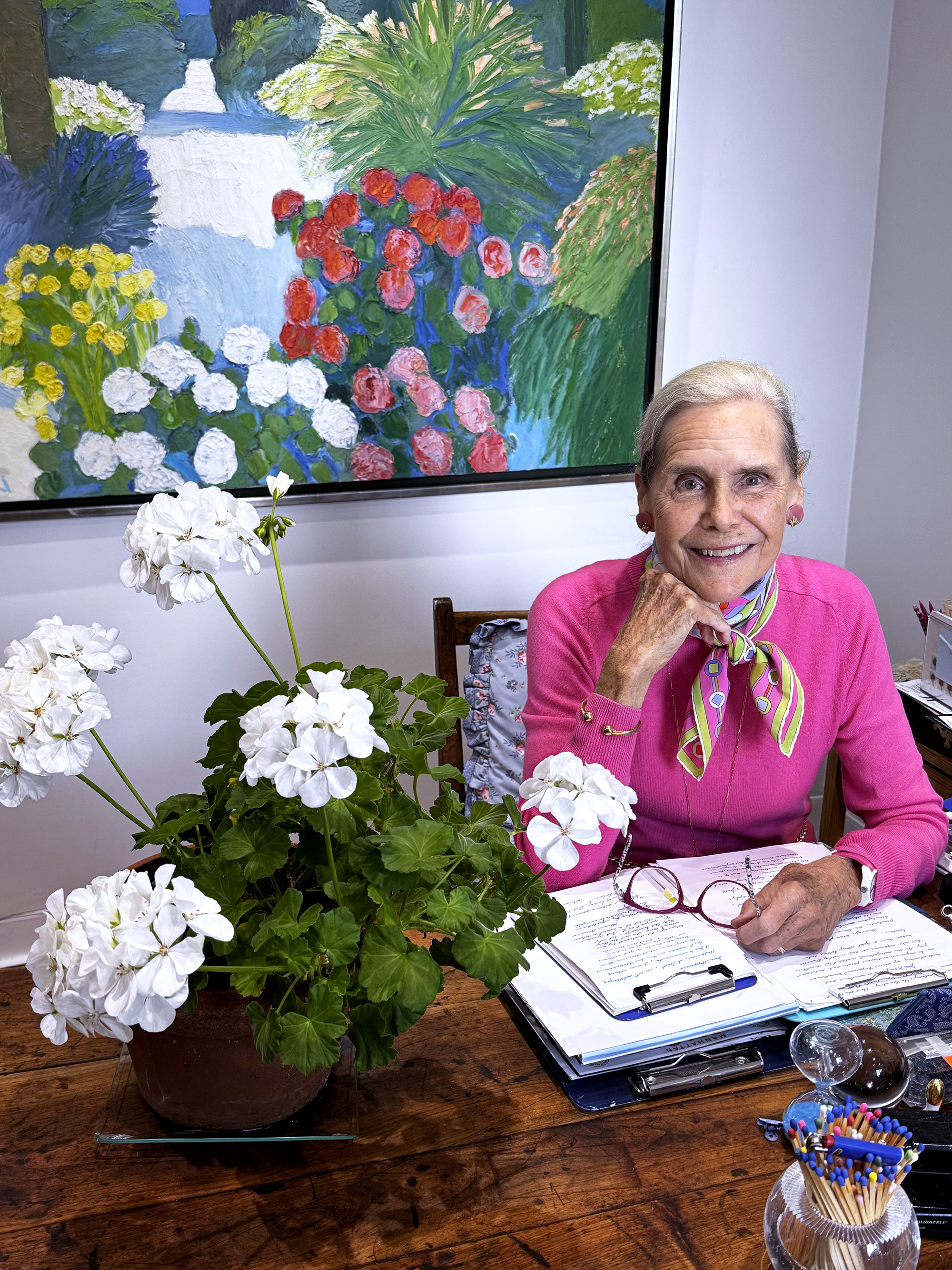
Photo by Elissa
Writing in my study, in front of my new Roger Mühl garden!
Dear Friends,
I love you. Vote!!
The month of October was full to the brim with all the beauty and joys of life’s changing seasons. The fall foliage’s autumn palette of peaches, oranges and yellows intermixed with all shades of green has its eye-popping pleasures on these dazzling, light-filled final days of warmth.
This time of year, New England becomes a destination for leaf gaping, and everyone becomes spectacular photographers simply because they’re enveloped in such awe-inspiring beauty. New England also is being increasingly recognized for its small local theaters, whose plays are excellent. I feel so fortunate to have seen three superb productions in October.
Arthur Miller’s classic Pulitzer Prize–winning play, The Crucible, was brilliantly brought to life at the Granite Theatre in Westerly, Rhode Island. I know two of the actors, but I had only seen one of them perform before. All the characters were beautifully rendered — some by highly professional actors, while others were acting for the first time — and everyone was wonderful.
Kelly Rae LeGault played the character of Mary Warren, the 18-year-old who was on trial for her life. The poet and writer Christie Max Williams played the judge. For the 20 minutes of the frightening trial scene that took place in 1692, at the Salem Witch trials in New England, it felt sadly contemporary, relevant, stark and intense.
Serendipitously, Kelly was on the bus with me the morning after The Crucible closed. She was utterly exhausted, spent, after 11 three-hour, soul-wrenching, austere performances. In the program, the president of the Granite wrote that The Crucible “cautions us about the impacts of fear, hysteria, ignorance and abuse of power through a narrative of conflict between personal integrity and social pressure.”

Photo by Elissa
The guest room is ready for my granddaughter’s visit!
The director Marla Ladd’s rendition of Arthur Miller’s script was powerfully performed. The play opened on Broadway in 1953 as a response to the McCarthy era. No one told the truth. “The Crucible was an act of desperation,” Miller wrote in a piece in The New Yorker in 1996. “The play’s exploration of mass hysteria, false allegations, pain, and authoritarianism resounds profusely in contemporary society.” Ladd asks us to look in the mirror. There are no heroes — “the characters exist in a morally grey world.”
She wrote:
Have we really changed?
What can we do to make a difference?
Where are you passionate about?
What will you risk to stand up for it?
Kelly’s credits include a George Orwell quote: “In a time of universal deceit, telling the truth becomes a revolutionary act.”

Photo by Elissa
Can you believe the geraniums in the window boxes are still thriving?
The Snow Goose
The soaring world premiere of the musical The Snow Goose at Goodspeed Opera House in East Haddam, Connecticut, was moving, tender, touching and unforgettably heartwarming. One of the lead characters in this play based on a novel by Paul Gallico was an amputee, Philip, who worked at lighthouse on the coastline of Suffolk, England, in the autumn of 1933, at the great marsh.
Because he was different in appearance and empathetic in character, he was mistreated by the people around him and called “the monster in the marshes.” When a snow goose is wounded and unable to fly, Philip nurses the goose back to health through tender, loving care. He meets Frith, who is equally empathetic to the “little bird.” The natural world connects the two in an unlikely friendship.
We are rapt in the drama of the next seven years, when the snow goose, being restored to radiant health, is able to fly home to Canada. One of the heroes of this moving musical is the puppeteer who brings the audience into this miraculous flight back home by flying the snow goose into the theater. We are rooting for her to take flight and are overjoyed when she returns to Philip and Frith.
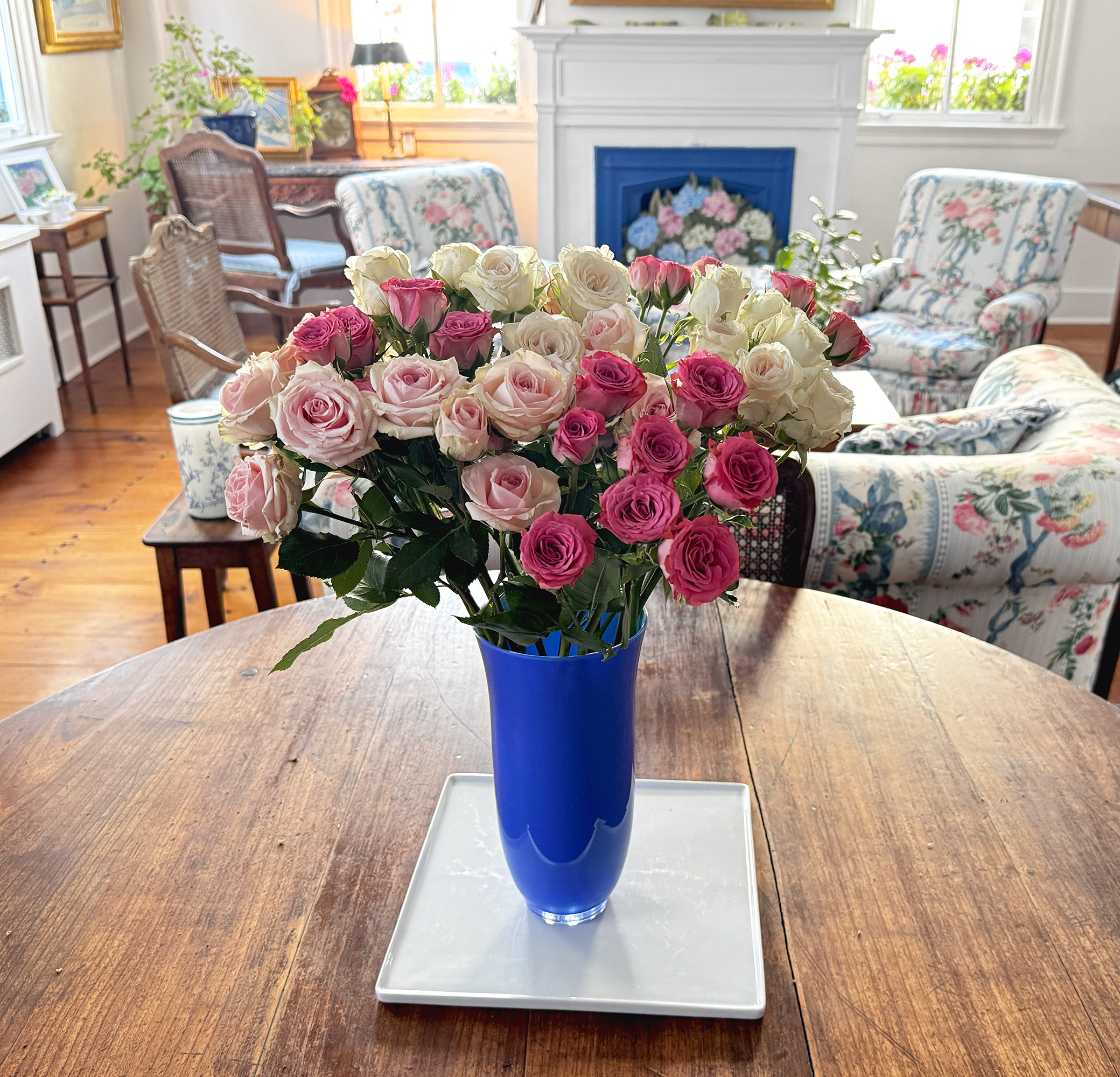
Photo by Elissa
These pink roses complement the chintz fabric in the living room.
The final scene of this musical, in the summer of 1940, shows Frith singing “The Call” and “Restless Sea” as she unites with Philip.
In program notes by the writers Scott Gilmour and Claire McKenzie, they describe how The Snow Goose, written 86 years ago during World War II, is a story about hope. “That even the smallest or seemingly insignificant life may leave an impact far beyond themselves. We’re reminded that where, when and how our specific lives unfold, we’re also reflecting the fundamental and never-changing aspects of what it is to be human.”
On a personal note, the woman who was at the door to greet me as I entered the theater enthusiastically smiled and said, “Enjoy the show.” I naively inquired, “Have you seen it?” She then introduced herself to me as Donna Lynn Hilton, the artistic director who had the vision to make the book into a musical. She told me she’d seen every show and is sad that this performance is the last. I told her that a friend’s friend loved the play so much, she went to three performances. The friend I was with told me she wasn’t prepared to cry. The entire audience was deeply moved. There’s talk of Broadway. No doubt, this touching story has legs.
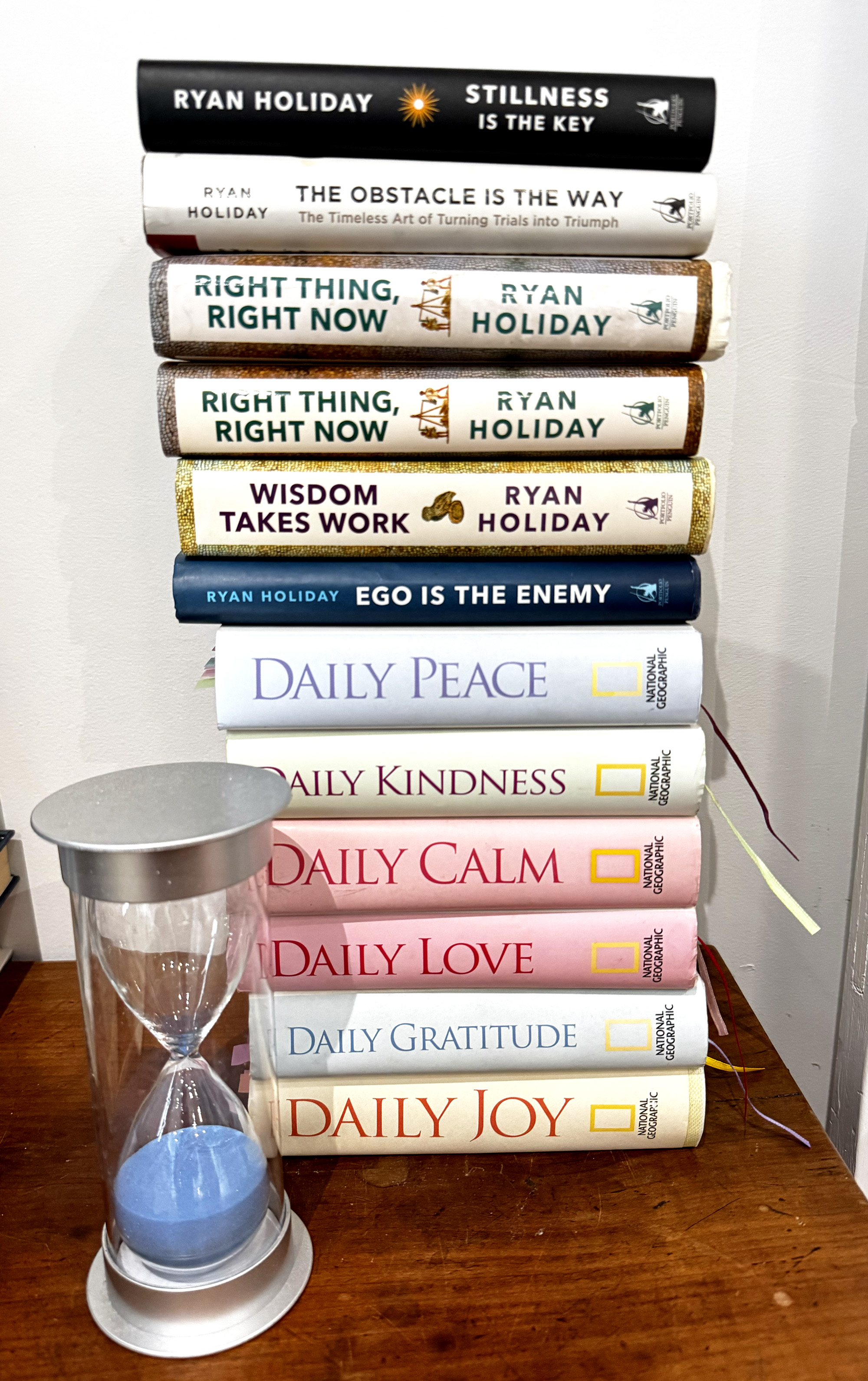
Photo by Elissa
A colorful stack of some books I revisit often!
A Piece of My Heart
Several years ago, I read The Women, by Kristin Hannah, a fictional account of the women who served in Vietnam. I enjoyed reading about their ordeal and was humbled to realize that about 11,000 U.S. military women served in Vietnam, and the majority were nurses in the Army, Navy and Air Force.
I recently saw a play about the same topic at the Ivoryton Playhouse. Before the last performance of A Piece of My Heart began, the director Jacqui Hubbard asked the audience how many had served in any wars — veterans from Vietnam, Korea, Iraq or Afghanistan?
When the war veterans stood, we all melted. Tears flowed before the show began as we clapped and clapped to show our gratitude for their service and sacrifice for our country. The woman seated next to me was Canadian, a Navy nurse now working at Yale in New Haven.
In the play, six women tell their dramatic true stories about the time before enlisting, their deployment to Vietnam and what life was like after their service. These brave women who served in Vietnam as nurses, volunteers and entertainers were underappreciated. This play acknowledged their roles as essential. A piece of their hearts went to all the brave servicemen who were in combat zones, always in harm’s way.
The 1986 play predated the Vietnam Women’s Memorial. As we know, women are increasingly serving in combat roles. Currently 227,000 women are in active-duty military in the U.S. Fifty years after Vietnam, we salute and pay “a tribute to all those who served and continue to serve,” as Hubbard wrote in the program, and witness a powerful reminder of the enduring cost of war.
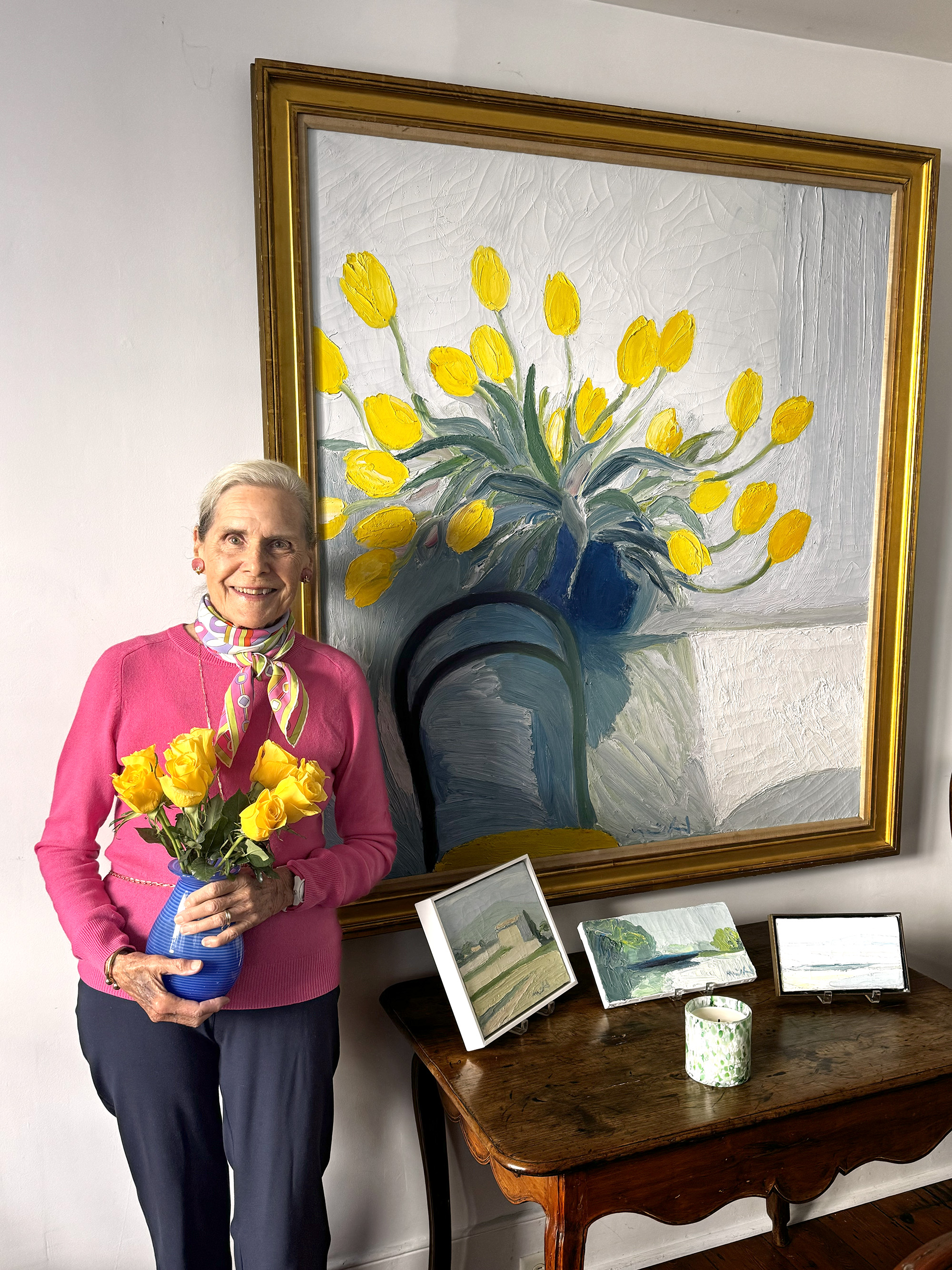
Photo by Elissa
As my mentor said, “Every room needs a touch of yellow!”
Life Goes On
On the first Sunday of October at the Garde Arts Center in New London, Connecticut, friends and I went to the Manhattan Short Film Festival to watch 10 short films from 10 different countries. The festival’s tagline is “One World — One Week — One Festival.” The exciting news is that we, the audience, voted on the one film and the one actor or actress we liked the best. “You be the judge!”
All the Manhattan Shorts are qualified to enter the 2028 Oscars and the filmmakers are voting members of the Academy. We were participating in the 29th Annual Film Festival that screens in 500+ venues from all over the globe and gives us a taste of the top 10 shorts they’ve selected. This year’s films were from:
- United States
- Ireland
- Australia
- South Africa
- United Kingdom
- Moldova
- Russia
- Cuba
- Georgia
- Mexico
I selected a winner! The 20-minute film Life Goes On won Best Film. The synopsis read, “Bill is ready for the end. The end isn’t ready for him. At 83, he finds himself caught in an absurd glitch: every time he dies, the day begins again.” Shutting our eyes and falling asleep each night is a mini death, especially when we’re in hospital care.
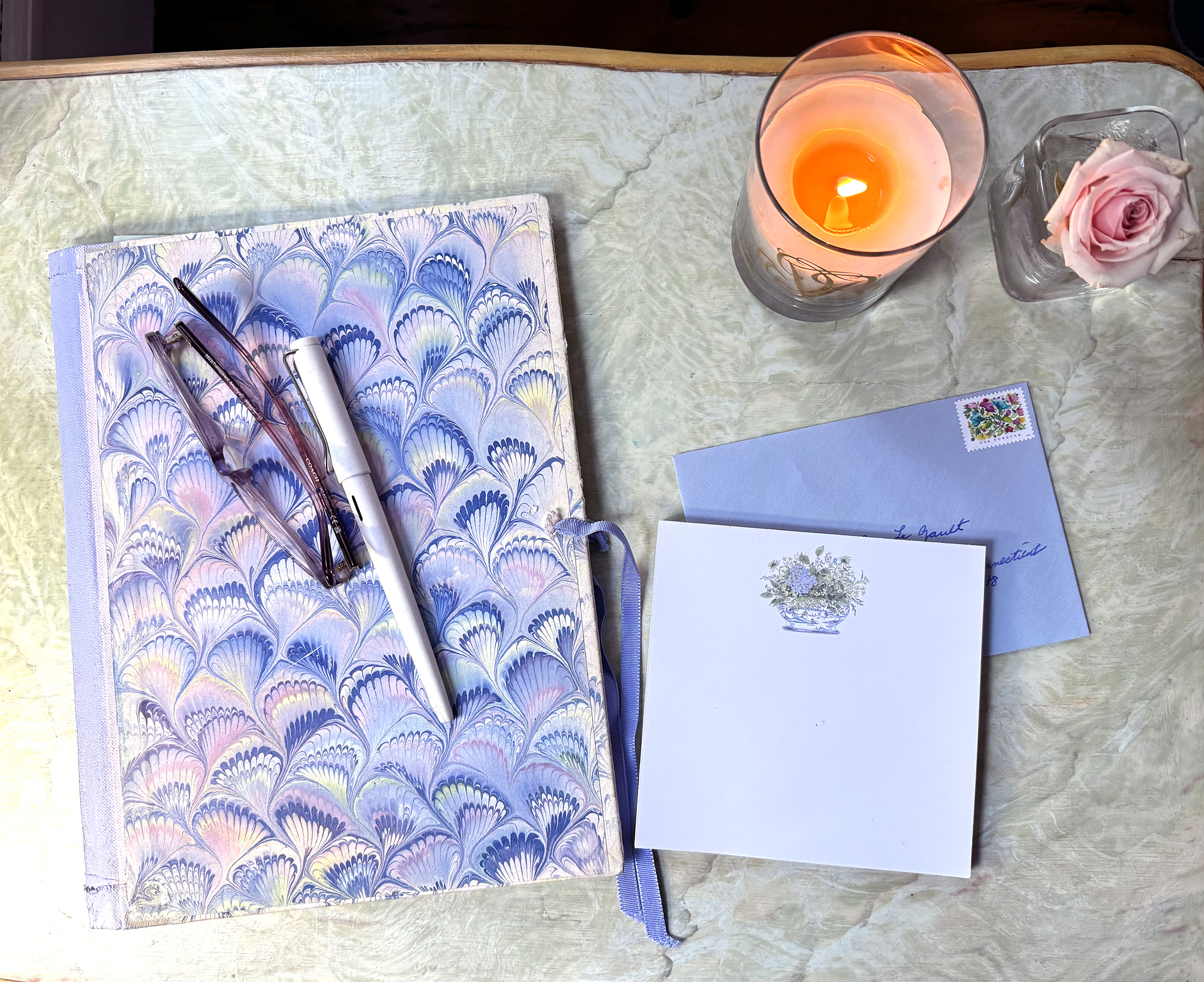
Photo by Elissa
My favorite place to catch up on my correspondence.
I was moved by this curmudgeon whose daughter comes to see him every night after she gets out of work. She kisses him on the forehead and tells her dad, “I love you.” Never a response from old Bill. Until … the lady next to him dies. Gone is her exuberant energy, her flowered bed coverlet, her cheerful stories and her family visits, and her sunny bed next to a window is empty. The bubble bursts.
When Bill’s daughter comes to visit, he awkwardly reaches forward from his bed and bursts out, “I love you.” He leans back into his pillow, is kissed on the forehead and stops breathing.
Love never dies. In the words of the poet Robert Frost, “In three words I can sum up everything I’ve learned about life: It goes on.”

Photo by Elissa
Each of these boxes tells a wonderful story.
An Evening with Arthur C. Brooks
My daughter Brooke and I went to hear a lecturer we both admire and whose teachings we have followed over many years, Arthur Brooks, at Fairfield University. He is best known for his lectures on happiness, a subject near and dearly central to my interests.
The bonus was that we had an early supper with Brooke’s daughter, Cooper, who is a new freshman at the university. Experiencing my granddaughter’s enthusiasm about her college life was so refreshing. Cooper absolutely loves her new life on campus. Her roommates, her dormmates, her classmates, her professors, the amazing food, her social life are all “perfect.”
Our wonderful visit with Cooper was a happiness boost before heading over to the auditorium to be among the 750 people in eager attendance. There’s something so elevating about collectively being in the company of curious, intellectually stimulating students and lifelong learners. Truth seekers. From freshman students to great-grandparents, from age 18 to 88, learning never grows old. Peter Brown’s motto rings true: “Always learning.”
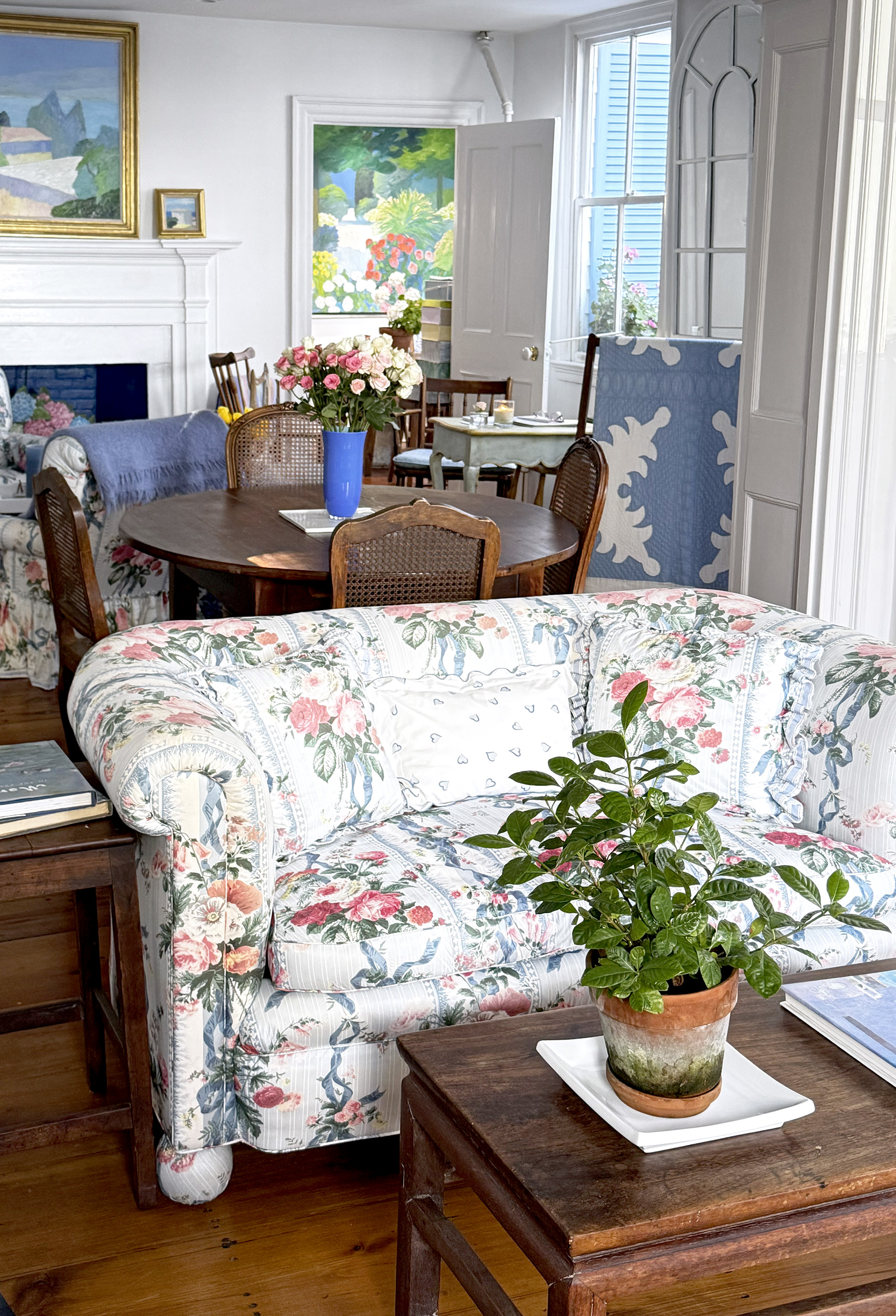
Photo by Elissa
I love the way I can see my garden painting all the way from the front living room.
Brooks’ talk, “Finding Meaning in an Age of Emptiness,” was a riveting 60 minutes of the latest scientific statistics about happiness. In 2008, there was a financial crisis, and it was the year of the smartphone. Because of the astonishingly quick cultural, economic, political and technological changes that affected every aspect of our lives, our sense of calm and inner peace are compromised. Brooks believes this rapid-fire, instantaneous communication reduces our ability to discern the depth and purpose of our lives. He asks us to reflect, Why am I alive? His latest book, The Meaning of Your Life, helps us seek and find ways to transcend ourselves.
Before the lecture began, we were invited to write down any questions we wanted him to address. There was an "in conversation" panel after to answer them. Brooks, along with the Fairfield University president, a professor of psychology and brain science, and a special assistant to the President of Arts and Culture, took turns answering thoughtful questions. We were full of hope because of the intelligent dialogue, laced with wisdom and humor to love one another and take time to give each other the greatest gift of all, our undivided attention.
Brooks put up a fantastical image of a human brain. On the left side was black-and-white machinery and technology, and on the right-hand side was an illustration of a brain decorated in a rainbow of garden flowers.
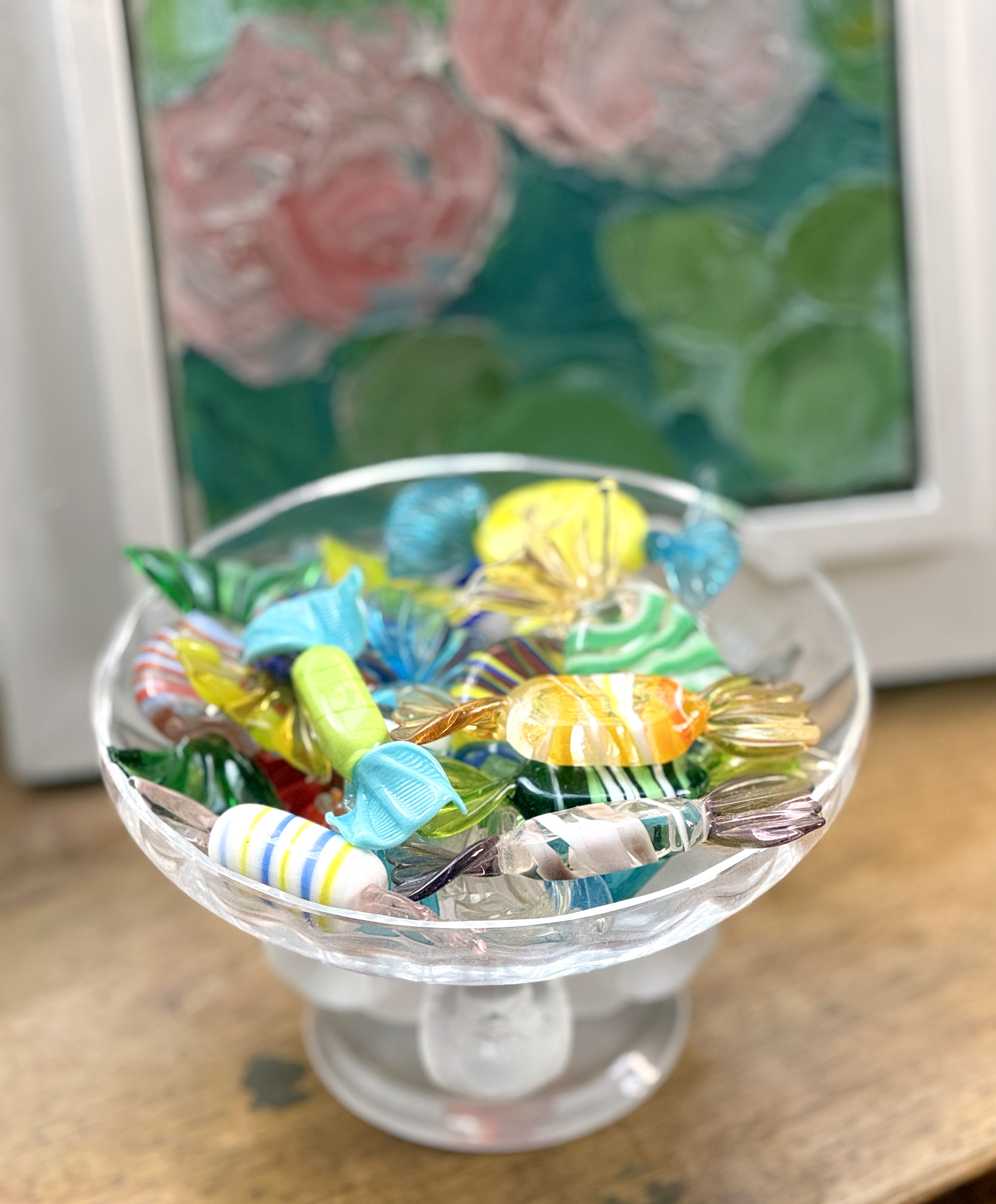
Photo by Elissa
These Murano glass candies look good enough to eat — almost.
Left side — complicated.
Right side — complex.
To illustrate his point, he then showed a car on the left side of the split screen. On the right was a photograph of Brooks with his arm around his wife. Cars can be built by design and repaired by a complex model of specific parts. “Complicated” can be solved once you figure out where the puzzle pieces fit. It’s helpful when you know ahead of time what the object you’re working on looks like and, in the case of a car, how it is meant to function.
Relation among human beings is, as we all know, complex. A loved one is not a mechanical car. When the car gets old, you turn it in and buy a new one. Jessica Grose, an opinion writer for The New York Times, wrote recently about “attention infidelity.” She learned that new term from Daniel Cox, a pollster and public opinion researcher.
Grose mused about the drastic difference between her experiences of “uninterrupted attention, general serendipity and conversational vulnerability.” Before smartphones, we had both hands free. We could hold hands with a child as well as a grandparent. We could wander about, absorbing whatever was beautiful to observe as we took turns telling each other whatever serendipitous thoughts come to mind. Together, we’re vulnerable as we listen intensely and learn what someone we love wants to tell us.
This physical proximity in the present moment can be extremely meaningful when both people are fully present. “Just because you can doesn’t mean you should.” Let technology be the elephant in the room.
I love spending quality time engrossed in deep conversation. Equally as important is my leisure time when I am indisposed. Just as living takes time, living well — when we are able to answer Brooks’ question, Why am I alive? — feeds the invisible soul we regularly nurture and cultivate for the benefit of all.
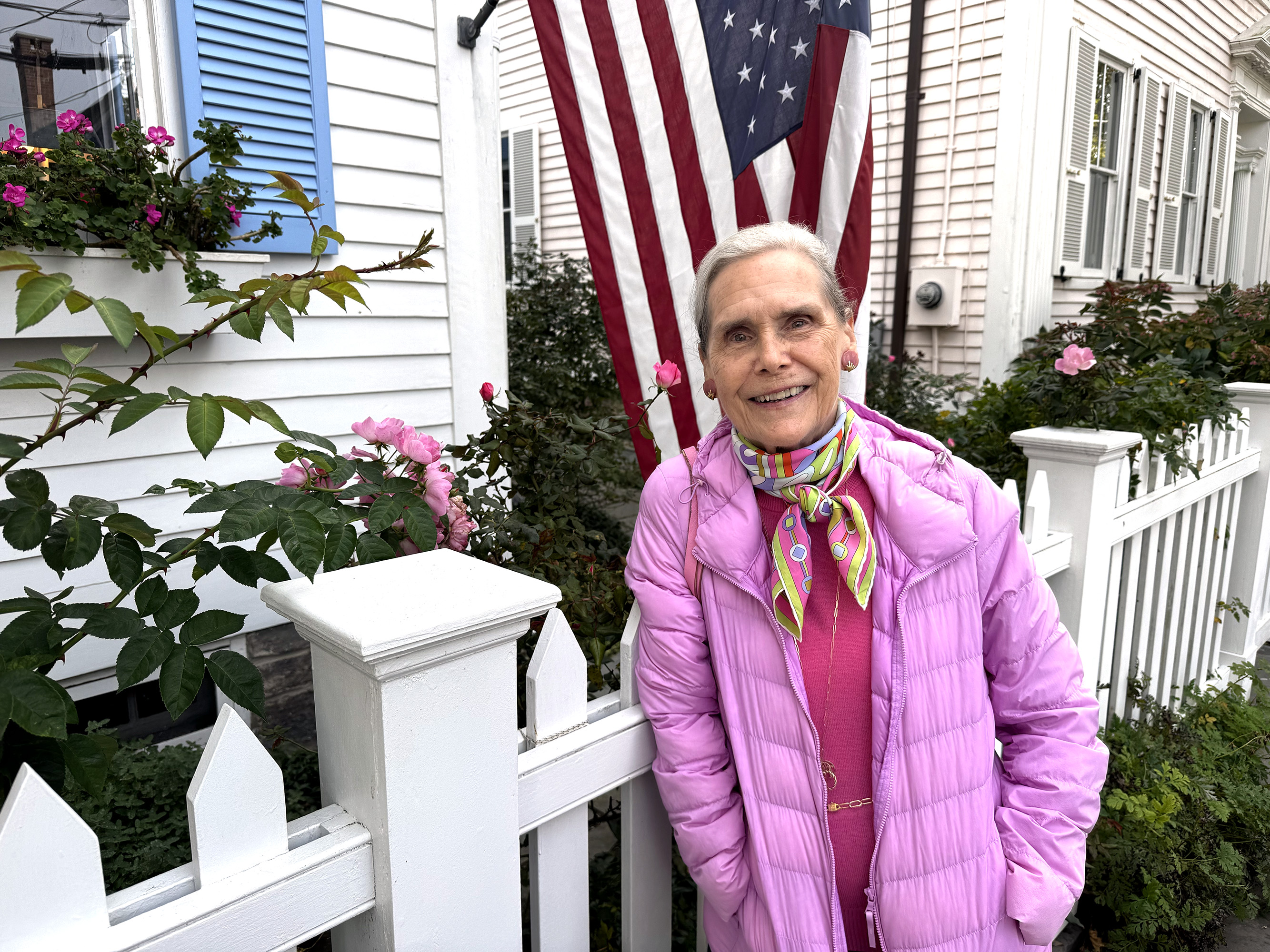
Photo by Elissa
My pink roses are still blooming in the front garden!
Appreciating Our Good Fortune
Often when I go out with friends to a restaurant, we’re asked, “Is this a special occasion?” Yes! We’re celebrating life — being alive. Having fun with friends. November is the monthlong celebration of my birth. I will celebrate turning 85 with both my daughters and intend to enjoy lots of festive occasions with friends and family. I love Thornton Wilder’s insight: “We can only be said to be alive in those moments when our hearts are conscious of our treasures.”
I’m well aware I’m at the banquet of life. Each day is precious. I’m aware of all the simple pleasures that sweeten my days, and I’m conscious of the satisfaction I get from doing easy little tasks that improve my spirit. George Sand understood that “Happiness lies in the consciousness we have of it.”
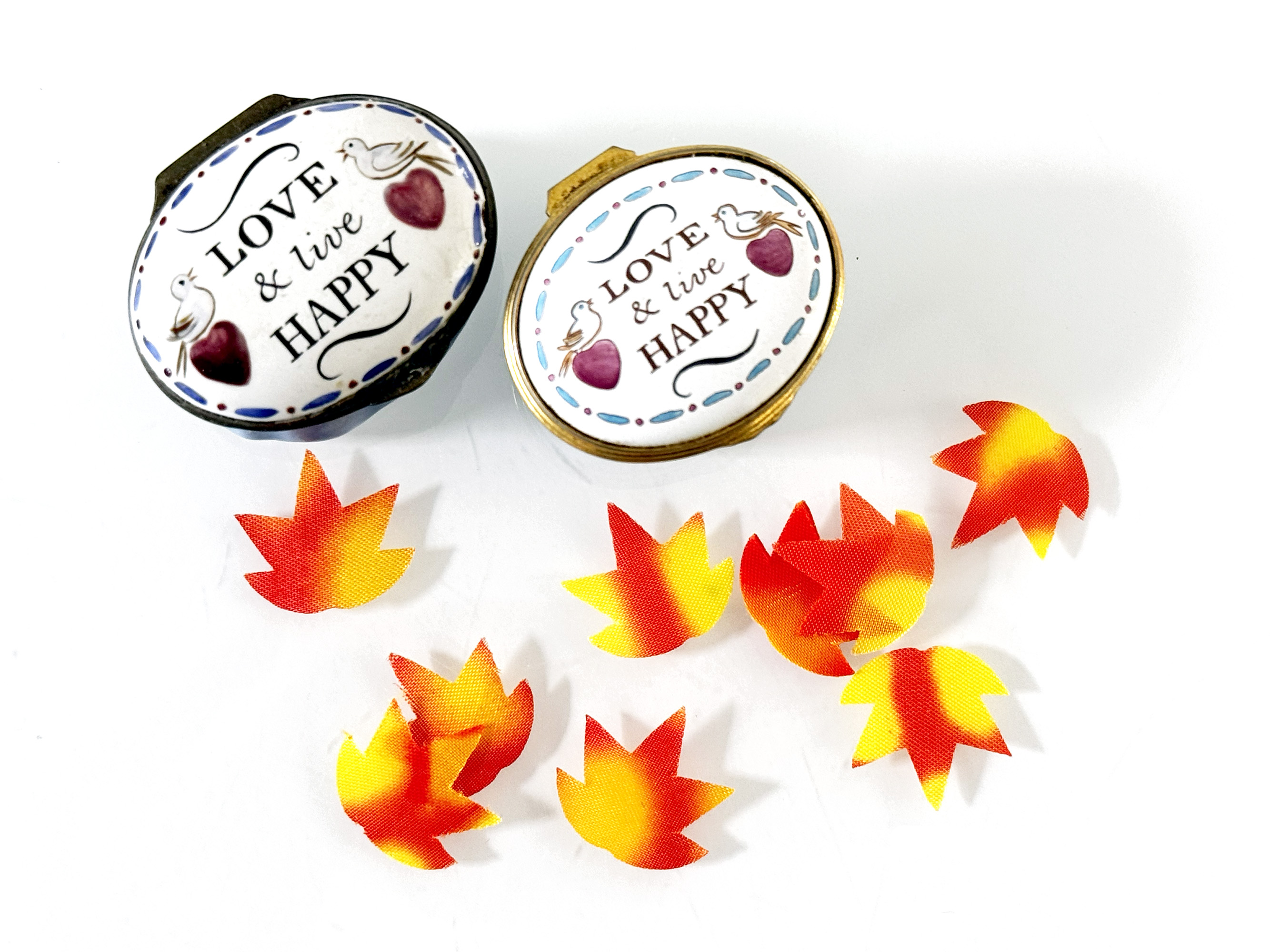
Photo by Elissa
Happy Thanksgiving!
The other day I came across some practical advice from my favorite president, Abraham Lincoln, and it has brought his bigger-than-life marble sculpture to life during these days leading up to the midterm elections: “Do not worry; eat three square meals a day; say your prayers; be courteous to your creditors; keep your digestion good; exercise; go slow and easy. Maybe there are other things your special case requires to make you happy, but my friend, these I reckon will give you a lift.” Whatever our “special case,” let’s do our best to make ourselves and others happy.
Whenever we stay centered in the present, with an attitude of appreciation for “our treasures,” we will waste no time to express our love. Emily Dickinson realized that “till I loved I never lived.” The poet from Amherst also knew that every experience in our life will never come again. This understanding elevates our lives to deeper depths and more soaring heights.
Happy Thanksgiving! I give thanks for you.
Love & Live Happy,

Please embrace your civic privilege and vote in this year’s election.
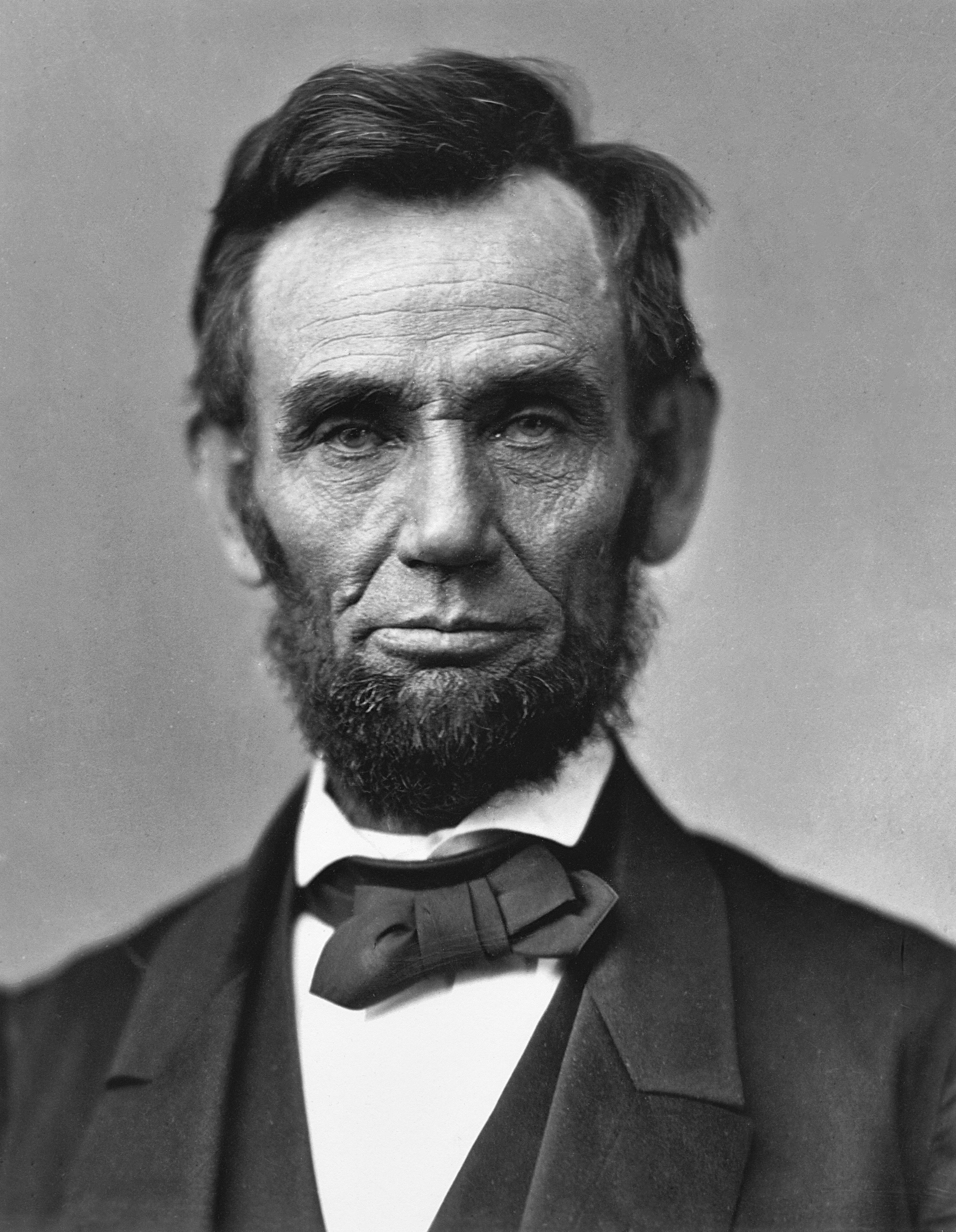
Here are some beliefs that my favorite president, Abraham Lincoln, expressed that inspire me to keep working for the good of our country:
“Let us have faith that right makes might, and in that faith, let us, to the end, dare to do our duty as we understand it.”
“The dogmas of the quiet past are inadequate to the stormy present. The occasion is piled high with difficulty, and we must rise — with the occasion.”
“Why should there not be a patient confidence in the ultimate justice of the people? Is there any better or equal hope in the world?"
“Important principles may, and must, be inflexible."
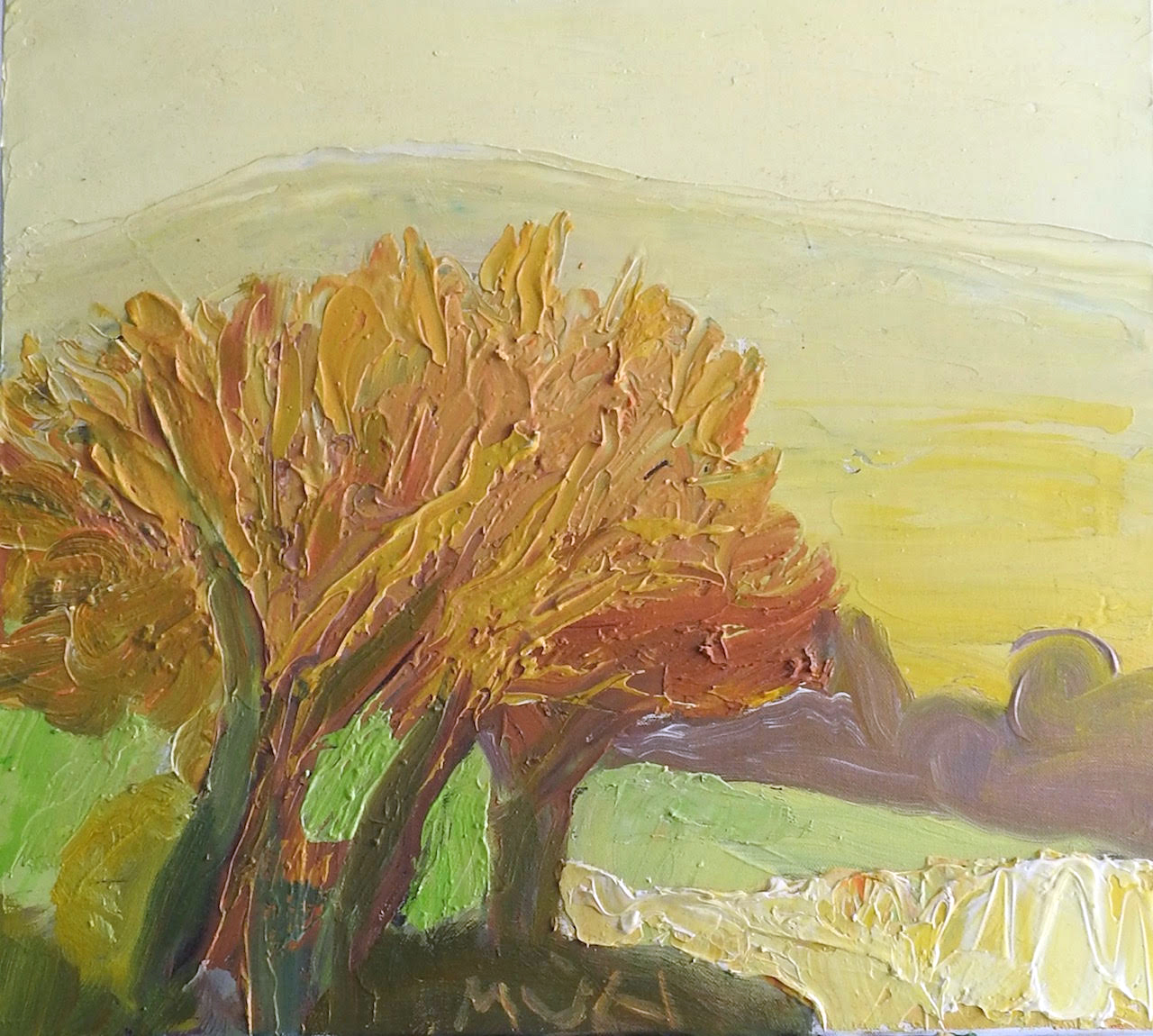
This month, I'm letting go of an oil painting by Roger Mühl if anyone is interested in adding it to their art collection. Please contact Pauline at Artioli Findlay (pf@artiolifindlay.com) for more information.
Roger Mühl (French, 1929 - 2008)
Automne
Oil on canvas
12 x 12 3/4 inches
Signed lower middle, “Muhl”
Painted ca. 2001
Roger Mühl captures the warmth and brilliance of autumn through vibrant color and richly textured brushwork.