AUTHOR | SPEAKER | PHILOSOPHER | DESIGNER

September 2026
date:
9/1/2026
“If you see someone without a smile today, give 'em yours.”
—Dolly Parton
January 19, 1946–August 25, 2026
(To Dolly, “I will always love you.”)
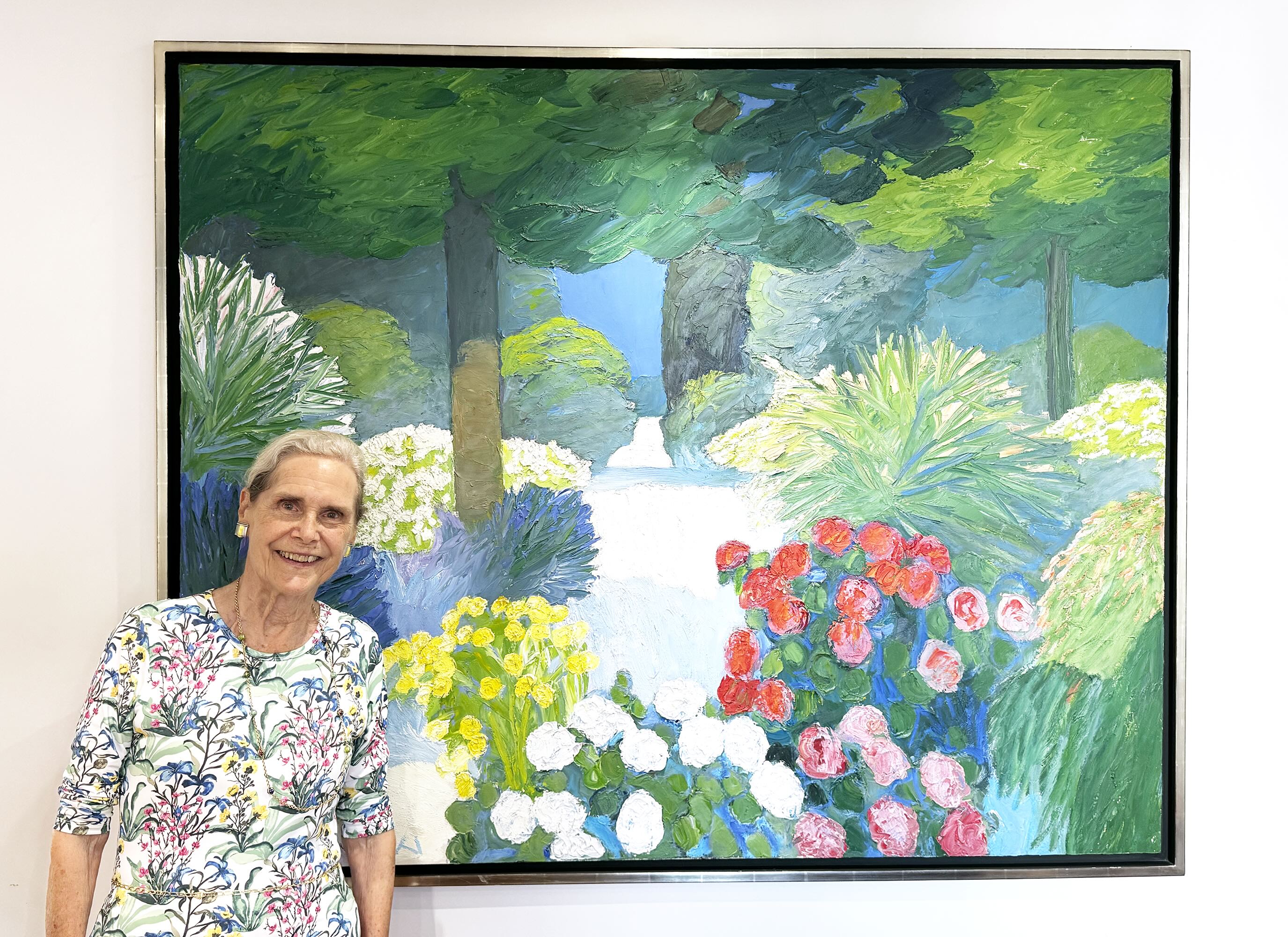
Photo by Elissa
I’m in love with my new Roger Mühl painting!
Dear Friends,
I love you!
Happy September. My most exciting news from the past month is the arrival of my new painting!
I hope you soaked in all the joy your heart could hold in August. I’m embracing the new beginning of September’s song.
Hill-Stead Museum
There’s something intimate and privileged about being able to enjoy art in the home of the collector. This gem of an art museum is a 1901 Colonial Revival–style house in Farmington, Connecticut. It was named one of the best small-town art museums in America by Travel + Leisure.
The only way to tour the museum is with a guide. All our bags were locked in cubbies. We were told an extraordinary story about a wealthy art collector who made his money in iron, lived in Ohio and whose daughter attended Miss Porter’s, the prestigious boarding school in Farmington.
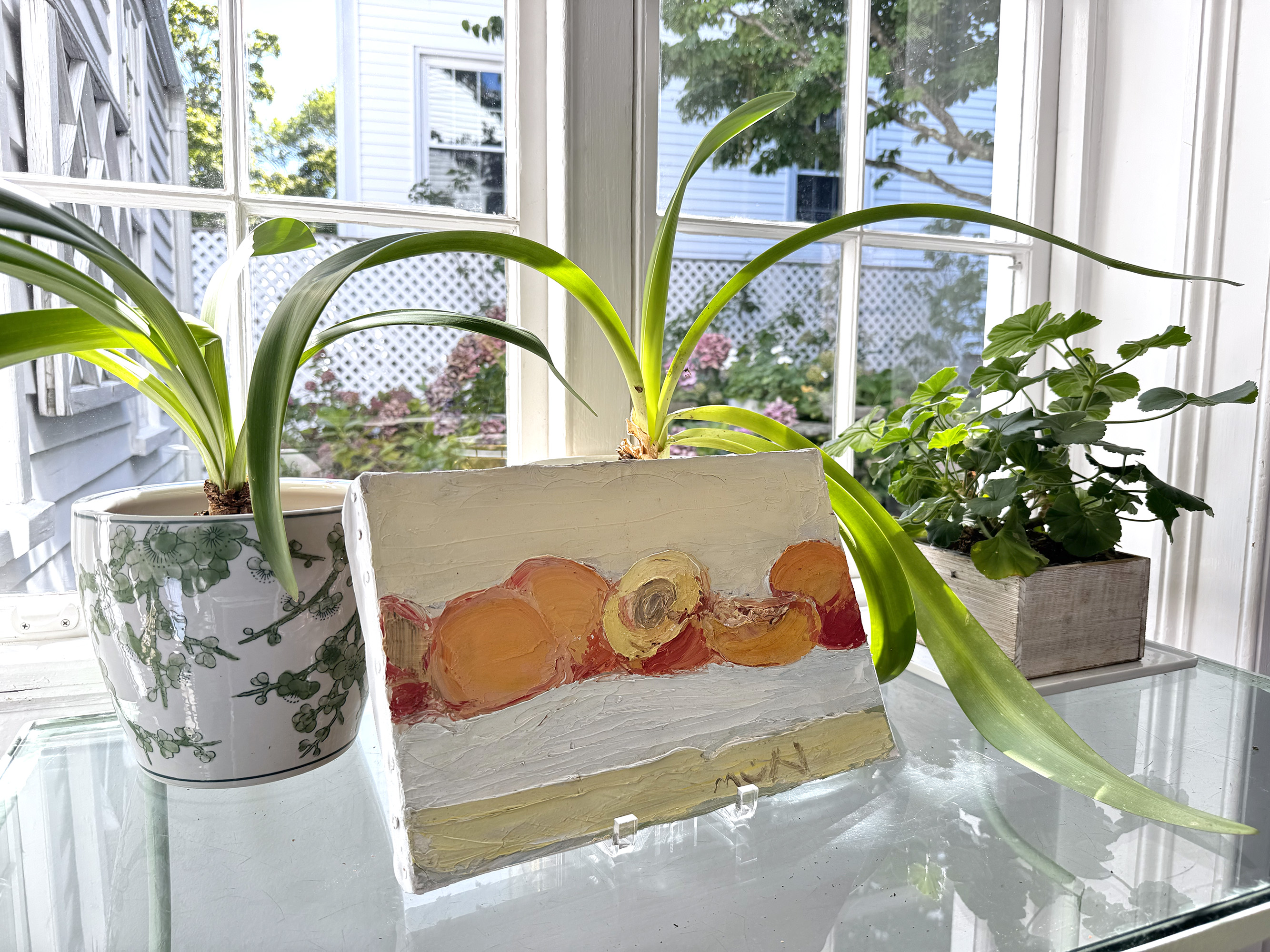
Photo by Elissa
Summer peaches for all year long!
Pope and her parents fell in love with the area and decided to come east to live there. She became a pioneering female architect and designed this elegant house for her parents.
Hill-Stead is located on 152 hilltop acres as a working farm. The surrounding meadows and gardens create ideal views from the handsome house that was home for her father’s famous Impressionist art collection.
Guests were invited inside all the rooms featuring excellent paintings by Monet, Manet, Degas, Cassatt and Whistler. Because this extraordinary collection is housed inside the collector’s home, you won’t see these paintings of rare aesthetic beauty unless you come to visit Hill-Stead Museum.
Architecture was not open to women in the late 19th century. Pope took a correspondence course to learn necessary architectural and engineering skills. Her father hired a top architectural firm to draw the blueprints for the house she designed. I feel certain the all-male firm hesitated to comply, but they did and opened a door for women in the profession. The home was completed a year after the turn of the century.
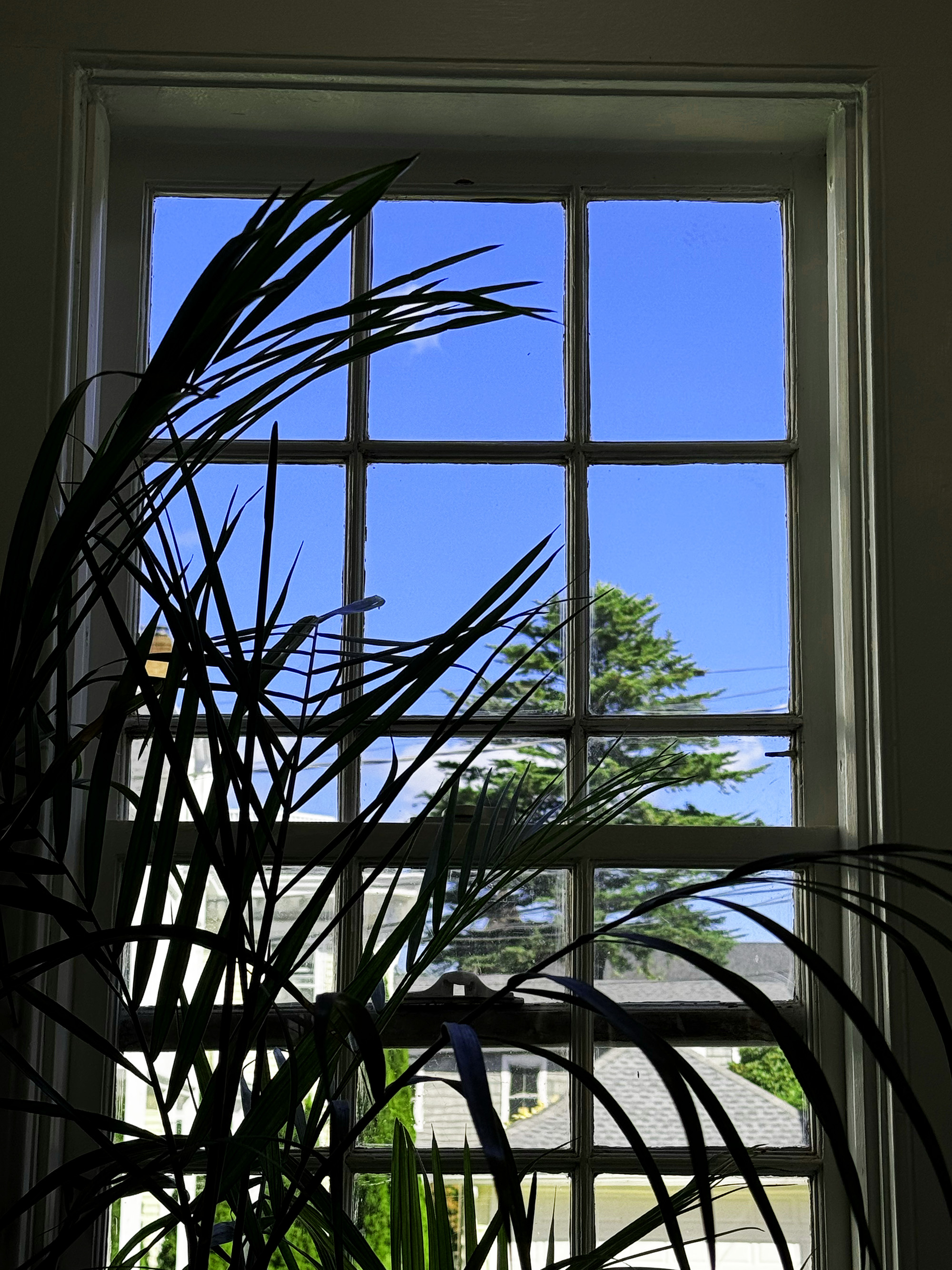
Photo by Elissa
I was dazzled by this blue sky out of the kitchen window.
Pope’s first client, her father, hired her to design a stately homestead that would meticulously tend to every detail to accommodate his wishes and needs and incorporate his art collection. Art was hung wherever there was wall space. As an architect, the swing of a door is an important consideration. Her father was exceptionally tall, and one example of Theodate’s attention to detail was the height of the windows — she placed the horizontal wooden sash of the double-hung windows so it didn’t interfere with his view when he was standing and seated. A grace note.
Reflecting on my visit to Hill-Stead, I am in awe that this small art museum representing one collector’s refined taste is located an hour and a half from Stonington. The authentic atmosphere is comfortable, down to earth and completely devoid of pretention. The French impressionist art is alive, and in a mysterious way, awakens in us an intense spirit-energy and also a deep calm. We’re able to gaze, pause, be in the painting.
In the living room, over the mantel, is a Monet haystack. On the wall immediately to the right is another haystack. Monet, always yearning to capture the quixotic light, painted haystacks in all weather over several years. Being absorbed in this artist’s energy, we feel these haystacks are illuminated from within by the changing waves of colored light.

Photo by Elissa
My blue “Happiness” stones, in a matching dish on top of a matching notebook, are a reminder of the importance of happiness!
A friend who also loves this collection asked me if I had a favorite painting. In a small sitting room off the living room over the mantel is another Monet, a landscape. In the foreground is a pastoral field, with sunlit trees overlooking the water. In the distance are some sailboats, the sails painted with one tiny vertical stroke of the brush. I learned this treasure cost six hundred and some dollars at the time.
It was fortuitous that Pope’s first client (her father) was an extremely wealthy, prominent person who entertained influential friends and important international guests in the beautiful house she designed. This no doubt helped her develop a thriving practice. Because Theodate’s father never questioned the expense, her future was bright. She traveled with her parents to Europe, exposing her eye to the finest examples of 18th century design and architecture. On these buying trips, they were able to purchase superior paintings by beloved master Impressionists as well as decorative objects that graced their home.
The success story of Theodate hit home to me because my mentor (and boss) Eleanor McMillen Brown (the daughter of an engineer who invented the American chef stove and founded the American Stove Company) was also an aspiring architect. It was in her genes. Born in 1890, 23 years after Theodate, she studied architectural interior design at Parson’s School of Design. She was a visionary and understood that the outside design of a building had to be able to satisfy the needs and desires of the occupants. Architecture and interior design are interrelated. Mrs. Brown was able to intelligently collaborate and contribute to every aspect of the building process because of her excellent reputation.
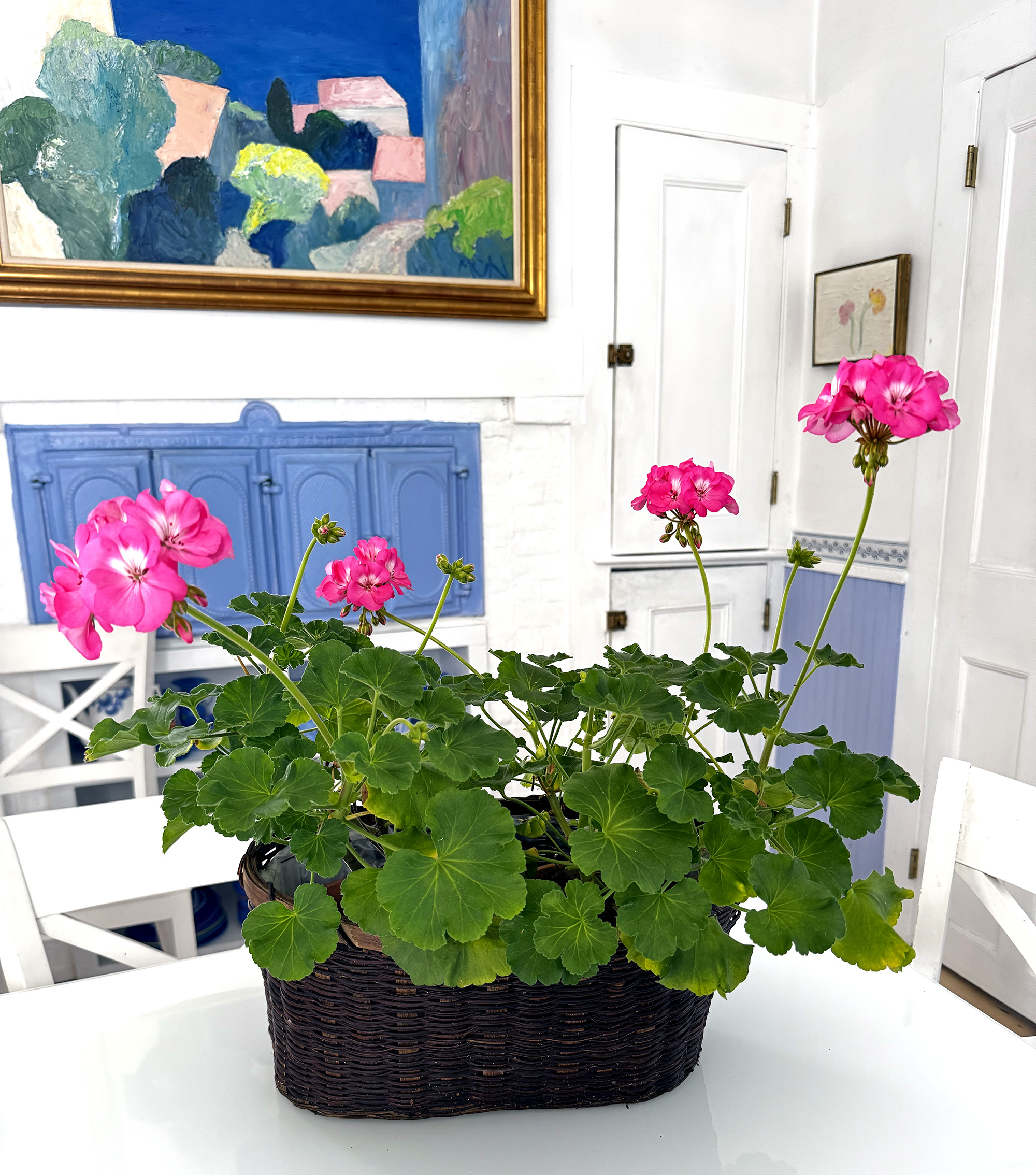
Photo by Elissa
I love a burst of pink in the kitchen!
I related to this lovely story behind Hill-Stead on so many levels. So many fond memories of my international interior design career flashed in my soul. I’ve seen so many hundreds of French Impressionist paintings over the expanse of almost 80 years. I wrote once about going to the Boston Fine Arts Museum with my mother and artist godmother to see my first Claude Monet painting. I became an art lover and collector as a teenager. I collect French artists’ work.
Another thought popped into my consciousness. My grandfather was a shipbuilder. My mother studied architecture under Vincent Scully. She also took correspondence courses at Yale while raising four children. She became an interior designer. Perhaps my spatial-relations skills were also inherited. I’m so fortunate my artistic mother encouraged my art collecting. The former president of Tiffany & Co., Walter Hoving, understood that taste is an expression of your exposure. I will always be grateful for every exposure I’ve had to beauty.
The day’s adventure to Hill-Stead moved me deeply. Art’s beauty is powerfully transformative to the cultivation of our soul. There are lasting echoes of illumination that continue to uplift and delight us long after our exposure. The British poet John Keats expressed my feelings beautifully: “The excellence of every art is its intensity, capable of making all disagreeables evaporate from their being in close relationship with beauty and truth.”
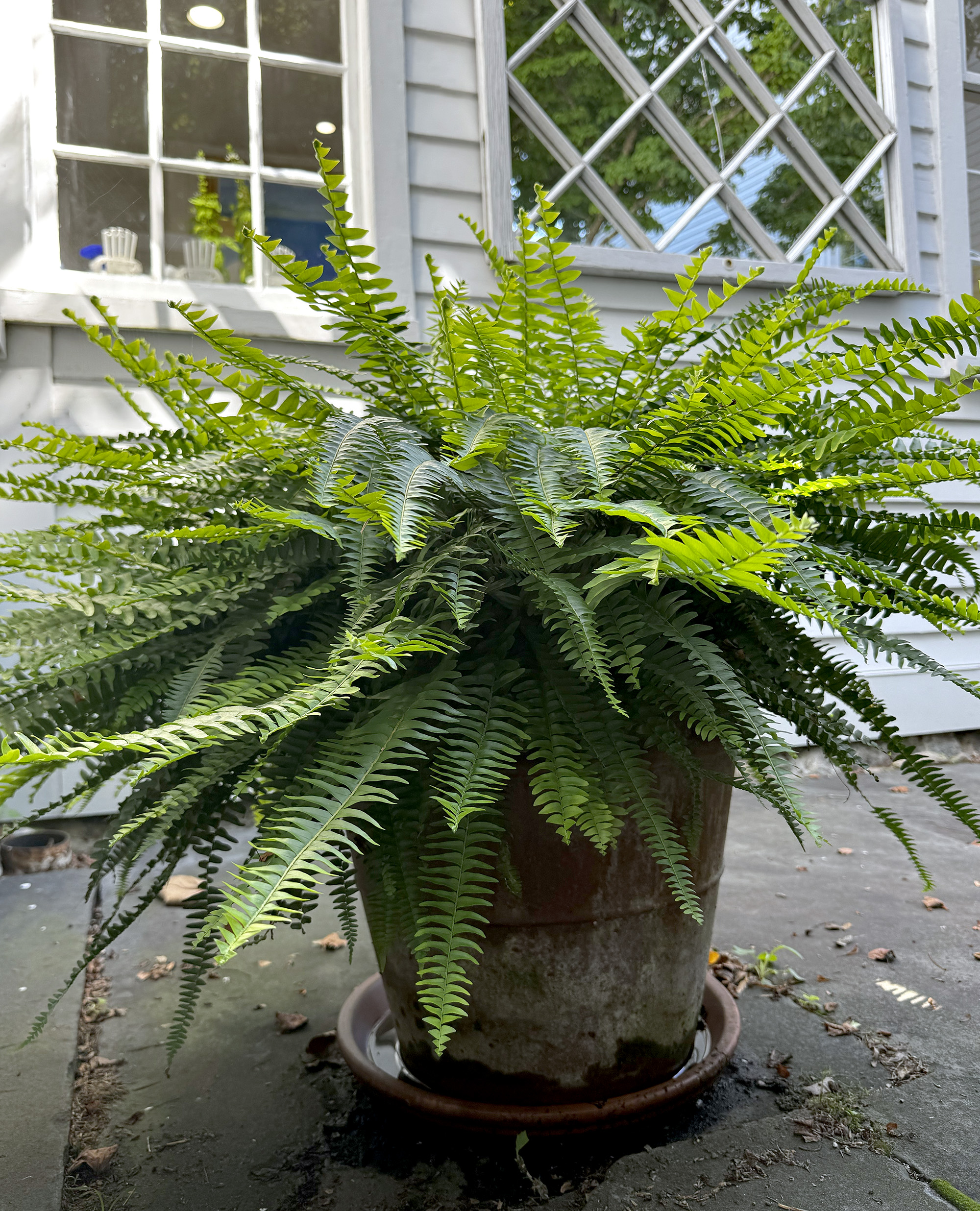
Photo by Elissa
My beautiful backyard fern is flourishing!
Are You a Fan of Charles M. Schulz?
Is Snoopy your favorite character of Schulz’s? I have a daughter who loved her Snoopy stuffed animal as a young child. On a family vacation in Madrid, Spain, she became inexplicably separated from her much-beloved bedtime companion. In a rush to leave the hotel, I reminded her to look under the bed, but Snoopy hid in the bed, under the messy pile of sheets. If you can relate, read on.
A new Snoopy never had the same snuggliness and couldn’t replace her original. After reading thousands of Peanuts cartoons over 50 years, Snoopy is still my favorite character.
Chérie, my reading friend, sent me another book to read that tickled my funny bone — Snoopy’s Guide to the Writing Life. On a manual typewriter, Snoopy sits on top of his doghouse and begins his first book: “It was a dark and stormy night.” Lucy gives a review: “This is your new novel, huh? I don’t know. I guess I have mixed feelings about it. I don’t know if it’s terrible or awful.”
Snoopy, the philosopher, writes about pain, joy, enthusiasm, frustration and the uncertainty of the unknown. We learn more about ourselves whenever we explore the human spirit together. The individual story becomes universal. As a writer, I related to the advice. Writing is hard work. Work hard, be patient. Don’t get discouraged. Love your work.
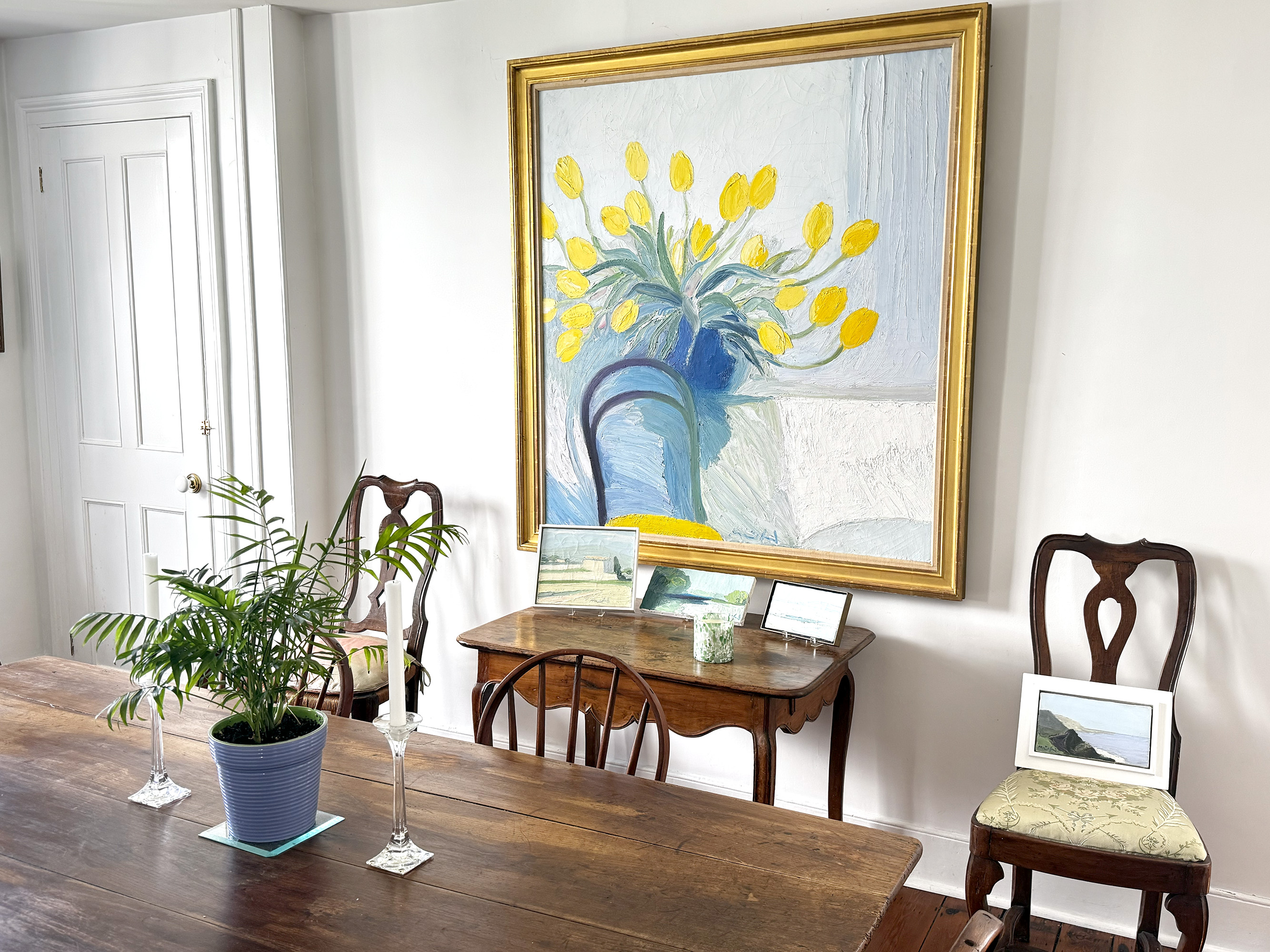
Photo by Elissa
I moved my yellow tulip painting from the living room into the dining room, where it is most at home.
Charles M. Shultz was best known for his comic strips. His son Monte wrote a compelling forward to this sweet tribute to his father. He explained that his father never thought of himself as a writer. He regarded “book writing as a higher form of art than his beloved cartooning.”
He was intrigued by language, those lovely sentences and clever turns of phrases, that have always made the written word so beguiling to readers of all ages. He once told me that the poet’s gift and artistic responsibility is to express the sorrow and beauty of life for those who cannot: a jilted lover who finds solace in a book of poetry or a traveler discovering the secret route to an undiscovered country in the ancient journals of those who have gone before. We read to hear those voices and learn from them.
Peanuts’ Snoopy was Charles Schulz’s muse, his way to writing about his favorite classical music and his most admired writers. We gain insights into a vast range of famous authors when Snoopy expresses his love of reading and the art of literature.
Snoopy’s literary ideas and fantasies as he attempts to write the great American novel strike a note in all writers’ hearts. Everyone, including Snoopy, has unique stories to tell, expressing the universal human (and dog) condition’s longing for self-expression. Because Schulz’s Snoopy is utterly adorable, we become his ardent fans. All of us who try to arrange and rearrange the right words in a sentence, on a page, to tell our story, can relate.
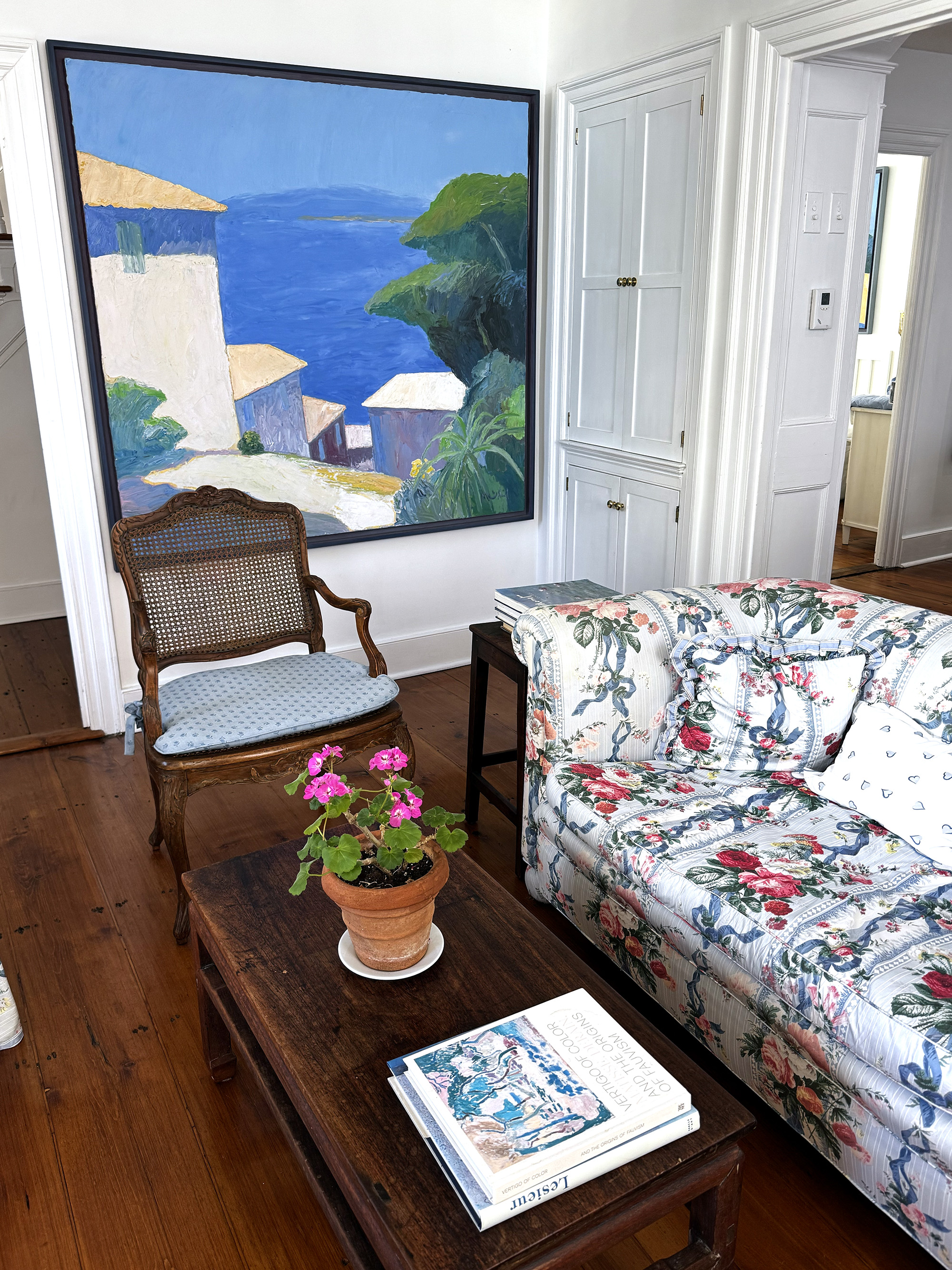
Photo by Elissa
The French seaside has replaced the living room tulips!
The writers’ delightful essays are poignant, personal and inspirational, telling their stories as they give advice to Snoopy. Sidney Sheldon wrote about his favorite cartoon. When he and Schulz were seated together at a literary award event, both were nominated for an Emmy. (Schulz won.) He told Schulz, “His was a story that had to be told.” Pause. “Well, maybe not.” Snoopy tosses the paper behind him. This is every writer’s nightmare. Is the idea worth writing about? Will the reader hate it? Am I wasting my time?”
Sheldon’s advice:
The rules for writing a best-seller are simple:
- Take an idea you really, really like.
- Develop it until it is brilliant.
- Rewrite it for a year or two, until every word shines.
Then bite your nails, hold your breath, and pray like mad.
Charles M Schulz died in 2000. Two years later, Snoopy’s Guide to the Writing Life was published. I enjoyed my romp back into Snoopy land. It was a pure pleasure to be reminded of Schulz’s genius and timeless gifts to us of all ages.
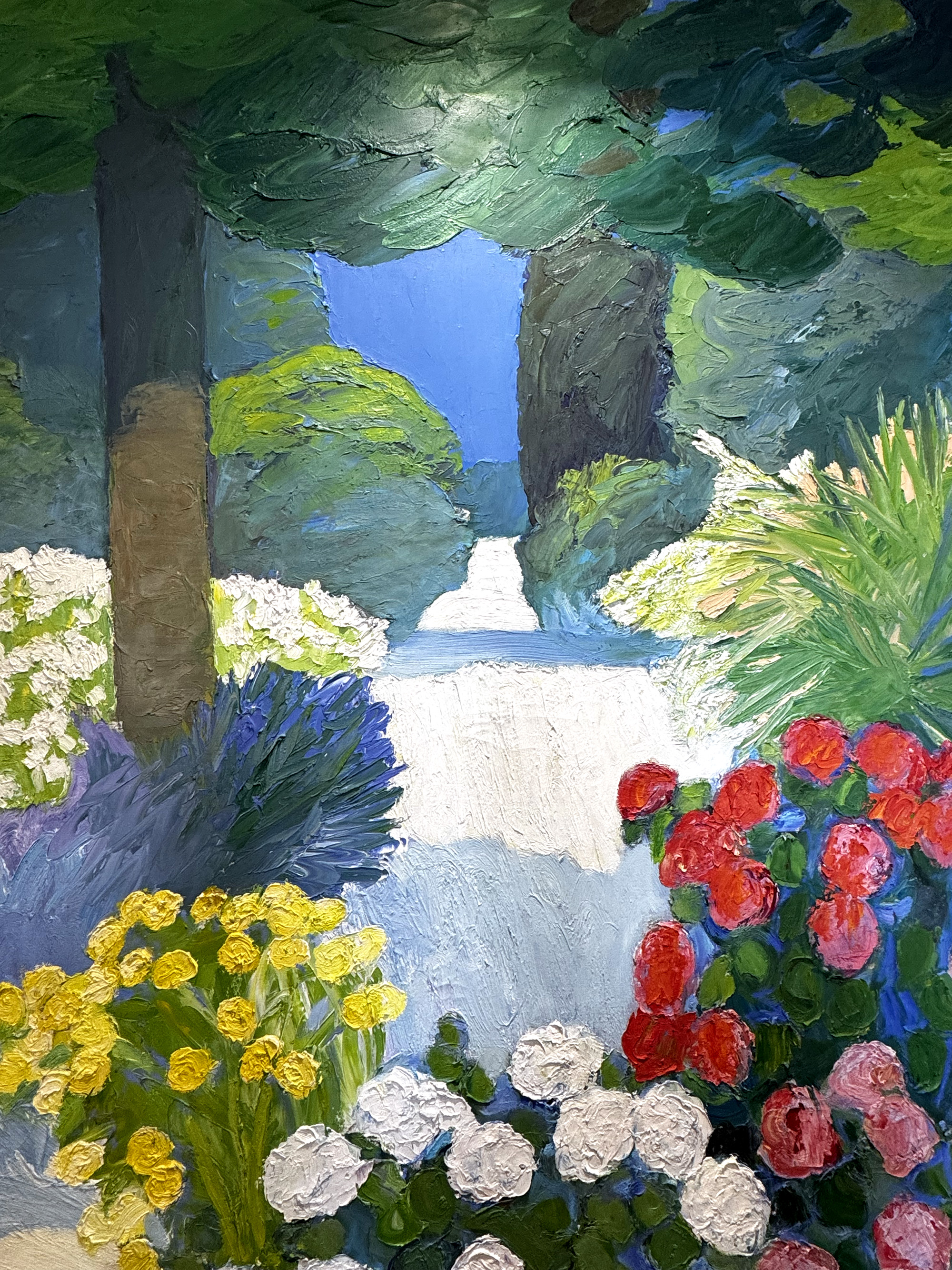
Photo by Elissa
Where do you think this this path leads? For me, it leads to the Mediterranean Sea.
“Garden in Summer” Arrived!
I waited patiently throughout June and July, and finally, on Monday, August 10, the garden painting I’d bought at auction in Fort Lauderdale was fetched. If it hadn’t been for my friends Brandon and Trish Watson, who enthusiastically offered to drive it to me, I never would have been able to rationalize bidding on it. They own Stonington Consign to Design right here on Water Street.
“We’re going to pick up another painting an hour away and can easily put it in the car,” they told me. “It will just fit.”
The anticipation of seeing the painting for the first time took over my aesthetic imagination. Rather than painting the walls of my mind with many beautiful pictures, soon a magnificent garden scene in full bloom would be hanging, physically, on the east wall of the study.
Brandon and I spoke shortly after he had the painting in the trunk of his car, snuggled under blankets.
All that week I’d clearly envisioned this explosion of beauty, sunshine and Mühl’s art-spirit energy enlivening the entire atmosphere of the cottage. I felt electrified with the excitement of my high spiritual expectations. As the English poet and artist William Blake understood, “Exuberance is beauty.” I felt electrified by the excitement of my high spiritual expectations.
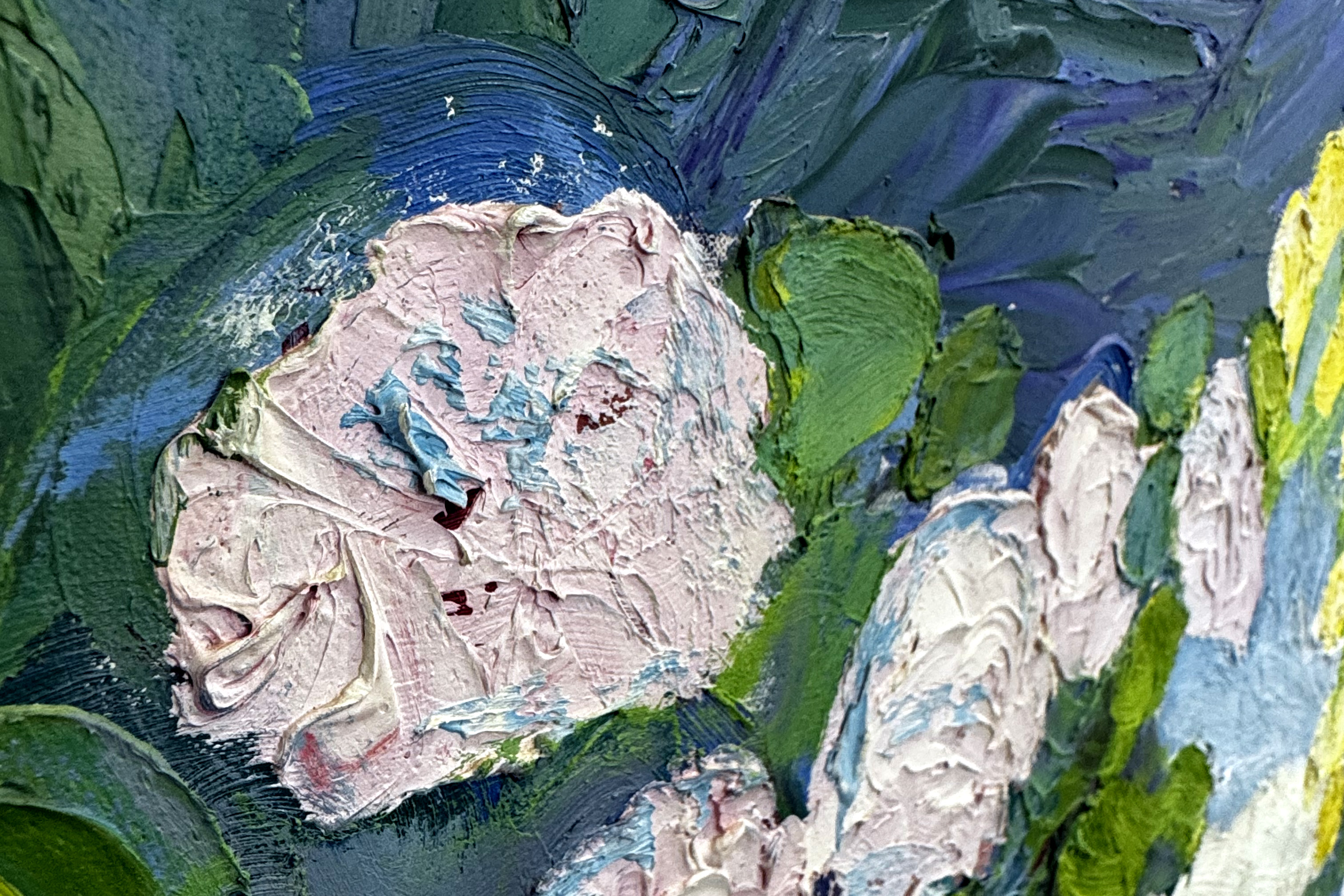
Photo by Elissa
These thick, creamy pink flowers look like frosting.
My mentor Mrs. Brown’s mantra was “When you change one thing, you have to rethink everything.” One thing always leads to another. Before the newly acquired painting was hung, I needed to rethink where the seascape would go that used to hang there. My spatial-relations skills were severely challenged. I needed to clearly envision six of my paintings being moved to a new home.
In The Nicomachean Ethics, Aristotle quoted Agathon, the fifth century BC poet: “Art is in love with chance, and chance with art.” This opportunity came to me by chance. Countless unknown, mysterious factors caused this lucky happening.
Mühl believed we should move our art around from place to place, because he didn’t want our eyes to get complacent. Six spaces would be transformed after the painting arrived through the front door.
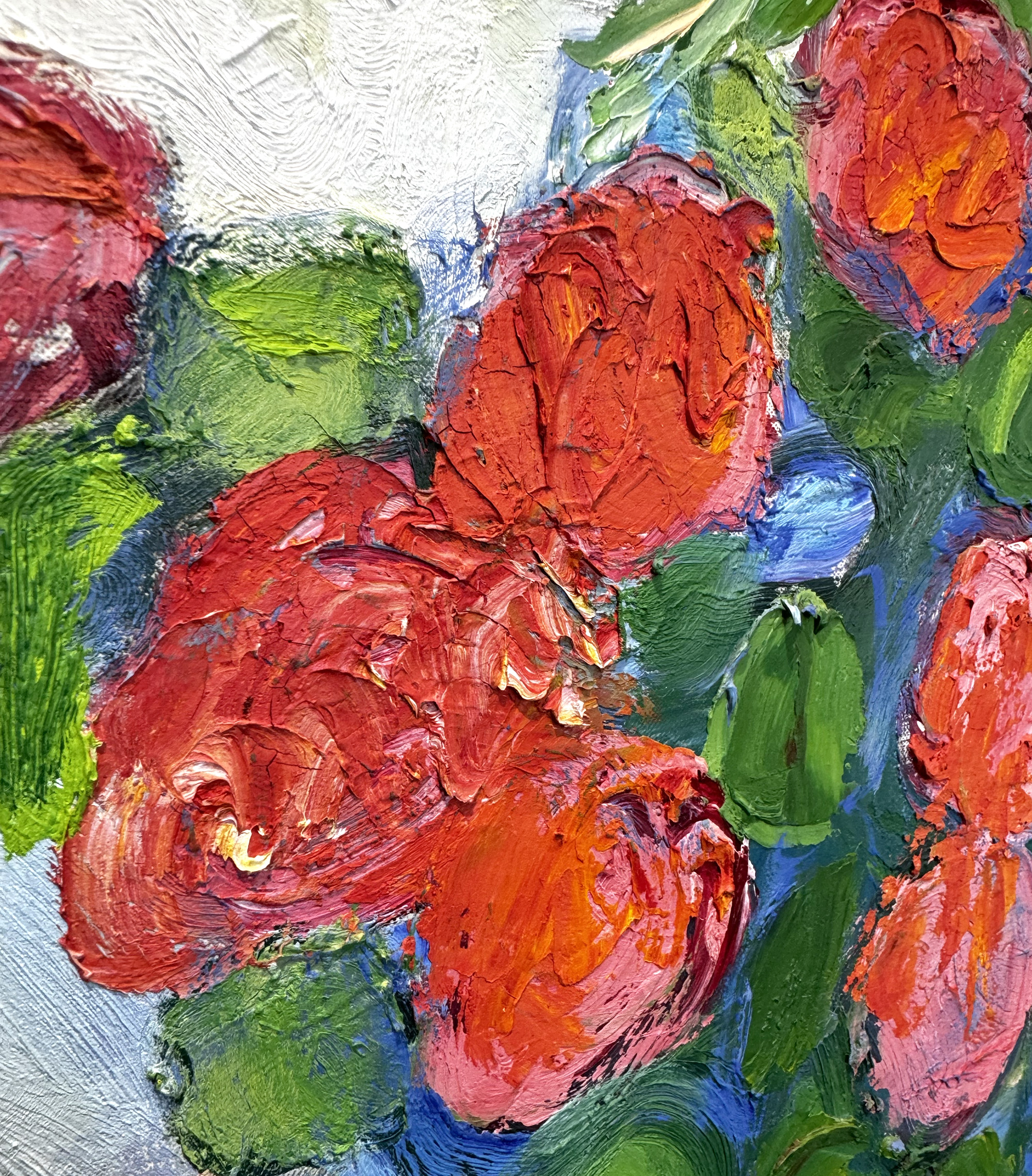
Photo by Elissa
A pop of pinkish red graces the bottom corner of the painting.
On Saturday morning, Brandon knocked on the door with Adrian, a friend (who lifts weights) whom he spontaneously asked to help him bring the painting out of the car. The car was parked a block away. Watching from my front gate, I saw as they removed the blankets, carefully sliding the painting out of the truck into the bright sunlight, and walked toward me holding the large canvas horizontally. Seeing this effulgent garden in full bloom, shining brilliantly toward the cloudless Mühl-blue sky, dazzled me.
I trembled in awe. My legs felt like jelly. Once it was hung, my body tingled with ch’i. This blast of rainbow-crayon colors in this beautiful garden has such depth, such vibrancy. I sat looking at what was before my eyes. I knew, without a shadow of a doubt, that it was meant to live in the cottage, with me.
The painting is alive with Roger’s exuberant energy, his love of life, his joie de vivre, his love of gardens, his love of painting beauty. I’m reminded of what the Impressionist artist Renoir knew: “It is not enough for a painter to be a clever craftsman; he must love to ‘caress’ his canvas too.” I sit in calm meditation, absorbing the depth of this garden path shaded by tall trees. Mühl’s vital energy is soothing, and all the years together, in France and in New York, flood my heart and soul with gratitude. All those years. I first discovered him in 1961 and then followed him throughout his artistic expression until his death in 2008. I feel he is present now, with me, in this garden.
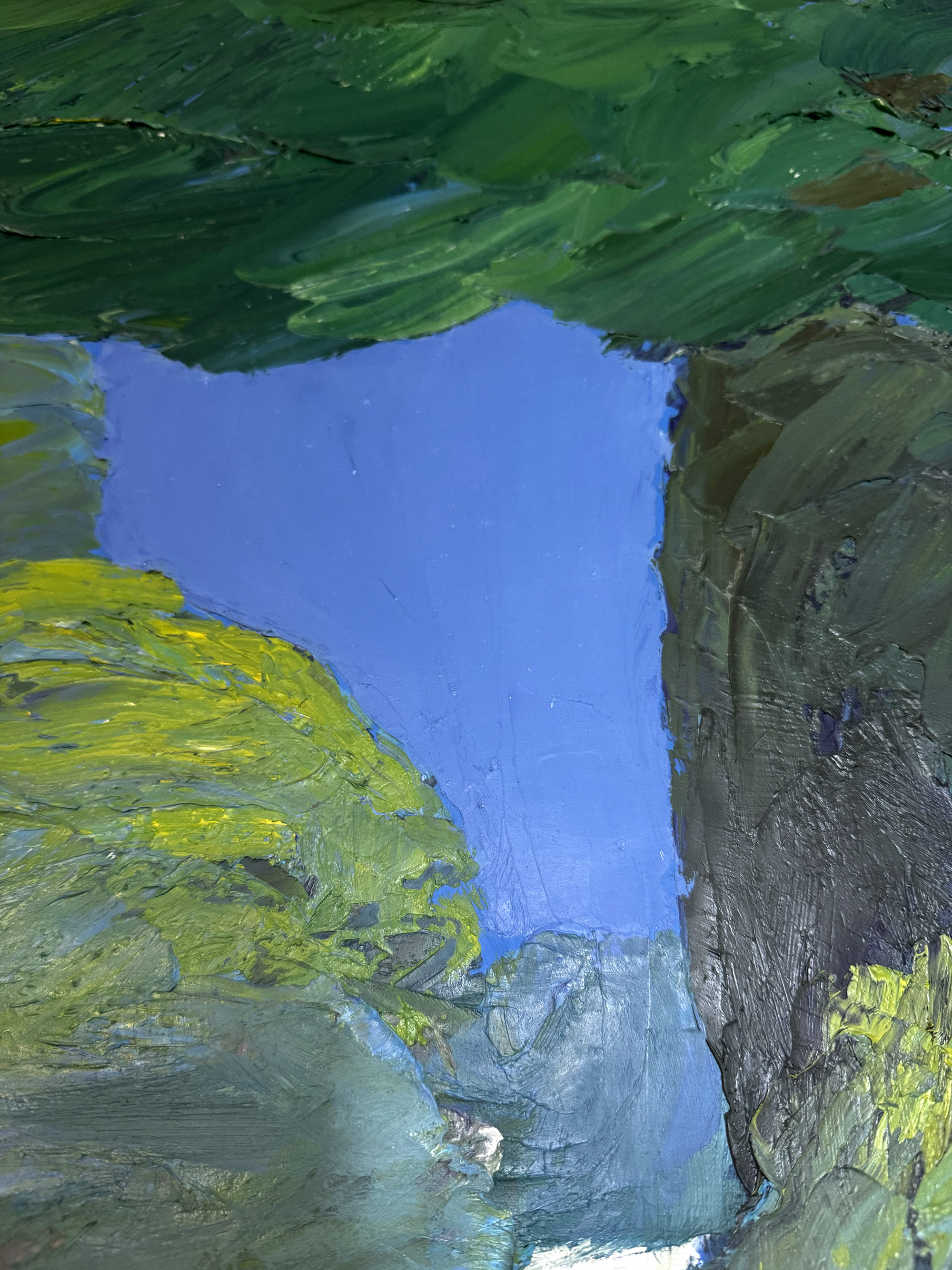
Photo by Elissa
The bright intensity of the blue sky in my Mühl painting is hard to capture in photographs, but delicious in person.
As I quoted last month, the 19th century French writer Charles Baudelaire expressed my feelings that “there are as many kinds of beauty as there are habitual ways of seeking happiness.” I am, by some miraculous set of circumstances, looking at happiness. Another French writer, Marcel Proust, reminds us: “Let us be grateful to people who make us happy, they are the charming gardeners who make our souls blossom.”
I love the way the fragrant path begins in the lower left of the canvas, overgrowing with pink, yellow, white and pinky-red roses that seem to leap off the canvas. There are lavender bushes among the roses. The apex of the path leads to intense Mediterranean blue sky, leading to the sea? The hidden dimension of this mystery is what’s so stimulating. We never know where the path of our future goes. Mühl has created beauty that pleases and delights the senses, mind and soul, leading us on our spiritual paths to great glory.
In closing, I’m full of love and grateful to you for our meaningful friendship that continues to uplift my spirit and bring me great happiness.
Love & Live Happy,


Photo by Elissa
This beautiful Streptocarpus on the ledge between Charlie’s and my yards is commonly known as the Cape primrose.
“All you need are these: certainty of judgment in the present moment; action for the common good in the present moment; and an attitude of gratitude in the present moment for anything that comes your way.” —Marcus Aurelius
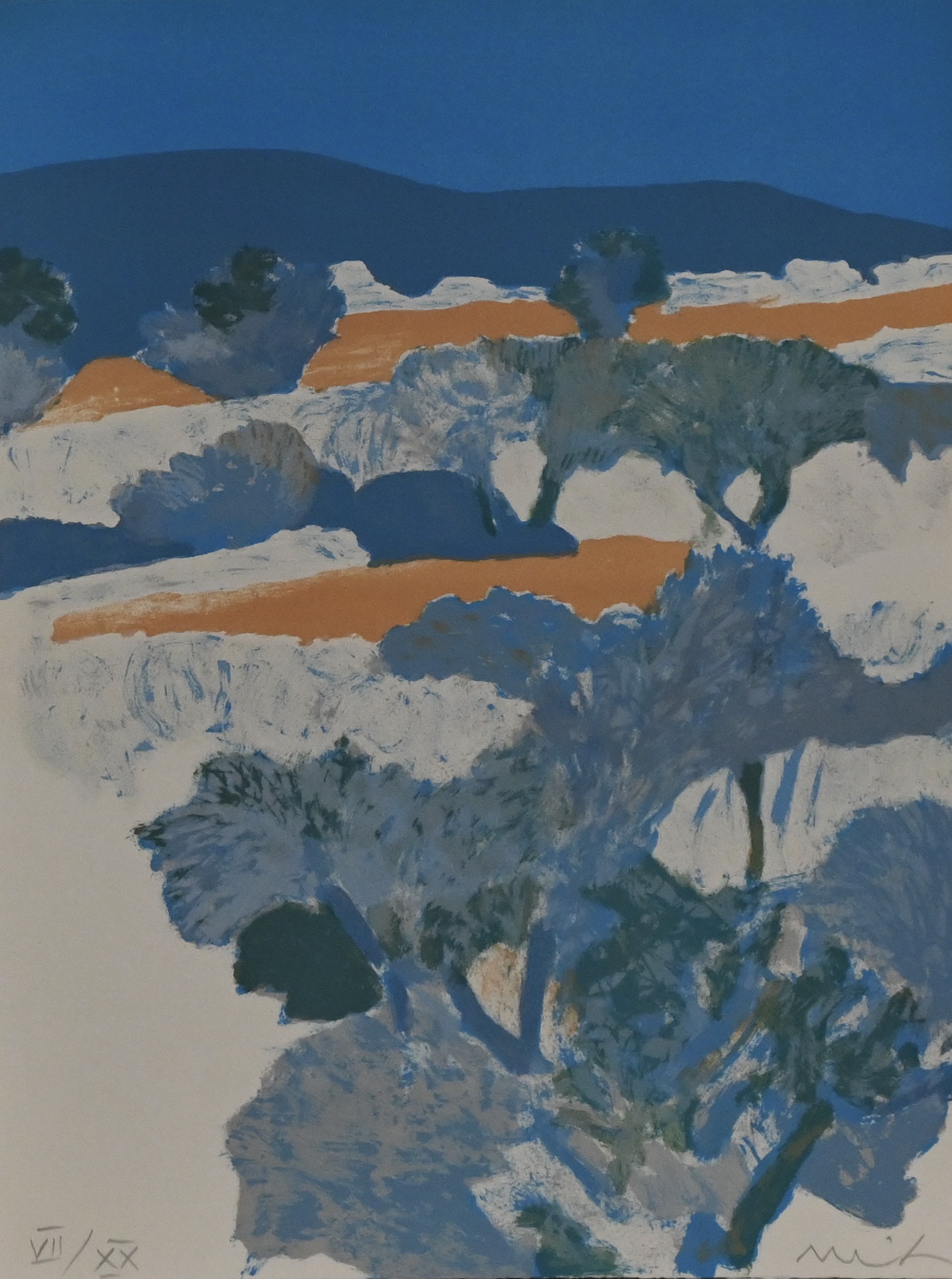
This month, I'm letting go of a lithograph by Roger Mühl if anyone is interested in adding it to their art collection. Please contact Pauline at Artioli Findlay (pf@artiolifindlay.com) for more information.
Roger Muhl (French, 1929 - 2008)
Provence VIII, Les vergers d’oliviers
Limited edition French lithograph
16 1/2 x 12 1/2 inches
The image is printed to the edge of the sheet of paper.
Edition #VII of XX
Executed/printed 1986
A quintessential Mühl Provençal landscape where cool blues and warm ochres create a serene rhythm of olive groves beneath the deep Mediterranean sky.
(Note from Elissa -- I accidentally labeled last month's painting as a lithograph, not an original oil painting. I've since fixed it!)
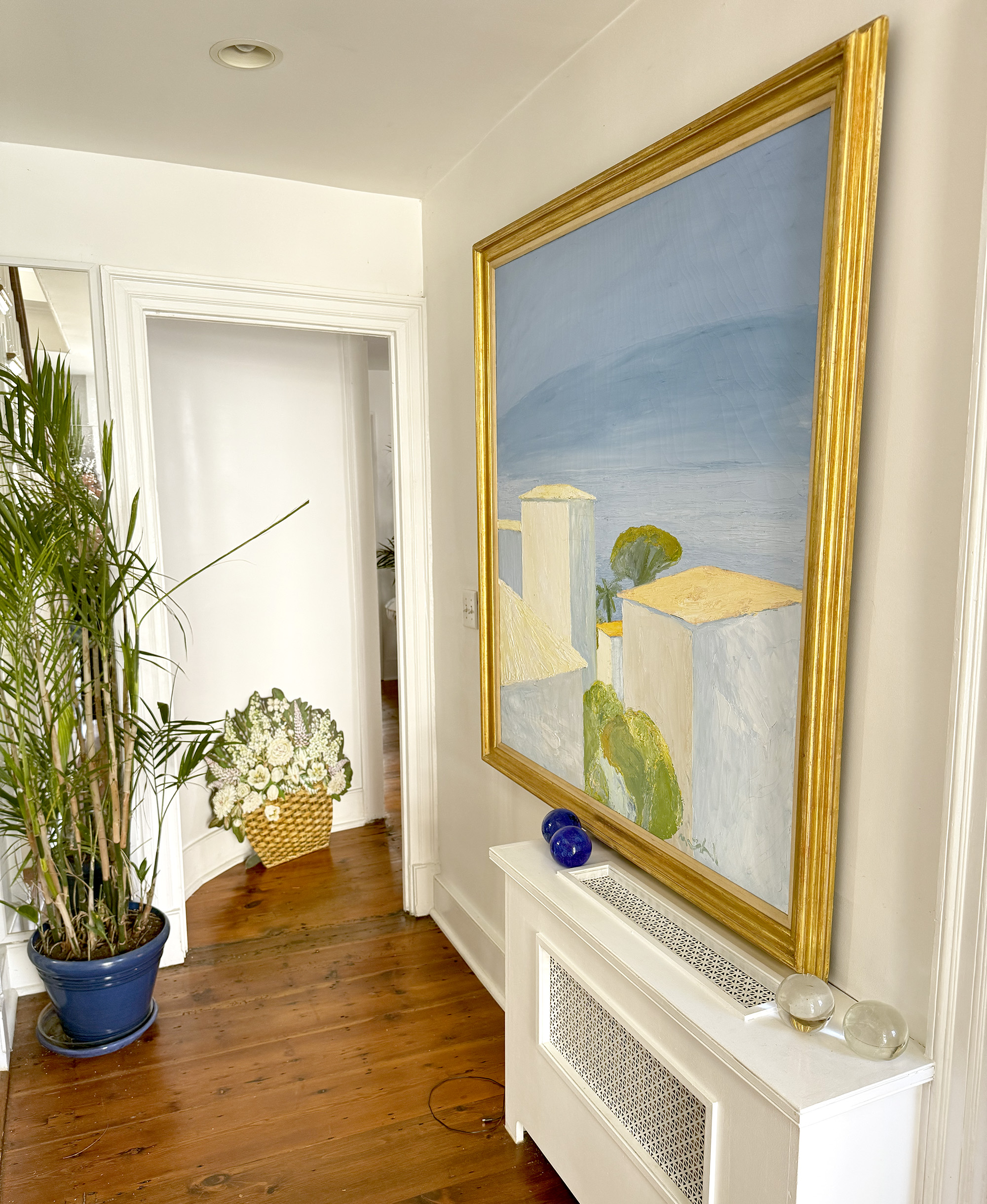
Photo by Elissa
The front hallway has a new life in the South of France with this painting.